
 A secret shared is a secret lost. And this goes double for spies. That's the message I take away from two books I just read, Charles Cumming's A Foreign Country and James Church's A Drop of Chinese Blood. Both Cumming and Church have intelligence agency experience (Cumming with MI6 and Church (a pseudonym) with the CIA in Asia) and their sophisticated books simmer with secrets, mysterious disappearances, double dealings, betrayals, conspiracies and hopes of redemption.
 A Foreign Country opens in Tunisia, where ex-pat Jean-Marc Daumal mourns for his 20-year-old British au pair, Amelia Weldon, with whom he was having an affair. Now her passport and belongings are missing and she has disappeared. As much as he loved Amelia, he wonders if what had bound them together was "a shared aptitude for deceit."
Flash forward thirty-some years to the present. Philippe and Jeannine Malot, an elderly vacationing French couple, are killed on the beach in Egypt. A "target" called HOLST is kidnapped in Paris. Thomas Kell (age 42, estranged from his wife and forced to retire from MI6 months earlier) receives a phone call from MI6's Jimmy Marquand. Amelia Levene, who's due to take over as chief of the British Secret Intelligence Service in six weeks, is missing from Nice. It's possible she's only having an affair, but maybe not. Kell is the only one who really knows what makes Levene tick. If he finds her quickly without attracting attention, all will be forgiven and Kell can come in from the cold.

 Cumming puts his SIS experience to good use. MI6 gossip and traditions, interrogation techniques (Kell has interesting comments about the CIA in Afghanistan), interactions between intelligence agencies and increasingly tech-heavy spycraft feel authentic and are woven tightly, with clear writing, into a labyrinthine plot. How easy for spies now to snap photos with camera phones, conduct research online, communicate via cell phones and email and use GPS devices for traveling and tracking. But how difficult to avoid detection, crack encrypted passwords, manage with no cell phone reception and escape being captured or killed! Whereas a spy's methods and equipment have changed, the personal toll of a career in espionage hasn't. I really liked the complexity and insights of major characters Thomas Kell and Amelia Levene. The villains are nasty, but Cumming makes them three-dimensional humans. The settings in France, Tunisia and England are well described.
A Foreign Country is Cumming's fourth stand-alone book and was published in 2012 by St. Martin's Press. It comes after last year's The Trinity Six and won 2012's Steel Dagger Award. Fans of John le Carré or Olen Steinhauer should enjoy it.
 Cumming's Amelia Levene is a beautiful woman but, according to A Drop of Chinese Blood's Major Bing Zong-yuan, Fang Mei-lin is the most beautiful woman in the world. For weeks rumors have been flying that she might show up in the far-flung Chinese town of Yanji, where Bing is director of the Ministry of State Security operations on the China-North Korea border. Bing's MSS superiors in Beijing have been happy with his record of controlling corruption and keeping Yanji as clean of North Korean operations "as could be expected." They've recently sent special couriers warning him that he's responsible for Madame Fang's safety. When she arrives, she refuses to talk to Bing and surprises him by her intimacy with his Uncle O, a wily police detective in Pyongyang until he left North Korea in a hurry and came to stay with Bing. O is supposedly working as a private investigator, but he spends most of his time in his workshop at Bing's home making plans for bookshelves. O and Madame Fang go out for the night and the next day O says they'll meet again. Instead, she disappears over the river into North Korea.
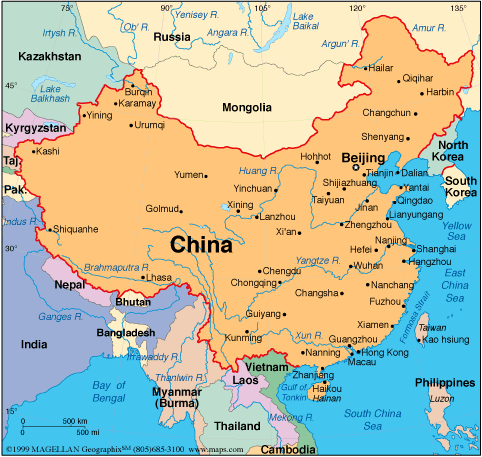 |
| Yanji, China is close to the northern tip of North Korea. It isn't considered a plum assignment for an MSS bureau chief. |


