The gathering storm. That's what Winston Churchill titled the first volume of his history of World War II, describing the period when the Nazis were gaining strength and the other European powers failed to see or deal with the impending threat.
The Versailles Treaty ending World War I placed a heavy reparations burden on Germany. The western powers insisted on Germany paying reparations in gold or foreign currency, and turning over more than a quarter of the value of the exports from its industries, which were Germany's key strength and had mostly remained intact at the end of the war.
During World War I, tight government controls on the press meant that German citizens had little idea that they would lose the war until it was suddenly over. In their shock and humiliation, they were ready to believe the stab-in-the-back story told by right-wing nationalist groups. According to this myth, the German armed forces didn't lose the war; instead, they were betrayed by socialists, communists and Jews in the civilian population and government, whose ambition was to overthrow Germany's monarchy and establish a republic.

Germany's postwar democracy was weak and tentative, and its economy precarious at best. Reparation demands for gold and foreign currency exceeded all of Germany's reserves, and attempts to buy foreign currency with German (paper) marks accelerated the devaluation of the mark. The result was the horrific hyperinflation of 1923, when workers rushed from their jobs with their day's pay to buy whatever they could, knowing that the money would likely be worthless the next day.
During the middle 1920s, Germany's economy shakily and tentatively recovered, only to be destroyed by the worldwide Great Depression starting in 1929. Two faiths now battled for the souls of the German people: communism and fascism. Extremist political factions raised their own private armies and pitched battles were regularly fought in the streets.
Many Germans concluded that the Weimar Republic was ineffective and doomed, and decided to support the Nazis, who promised order in the streets, full employment, the end to payment of reparations and a restoration of national pride through the resurrection of its armed forces and reclamation of lands lost through the Versailles Treaty. Fearful of the communists and weary of the political and economic chaos of the postwar years, enough Germans were persuaded to support the Nazis to result in Hitler's becoming Chancellor in January, 1933.
That the Germans had made a deal with the devil became clear almost instantly, as the Nazis moved quickly to outlaw or co-opt all other political parties and changed the constitution to allow Hitler's government to act unilaterally. The Nazi party's propaganda machine went into high gear, promoting the notion of a great Aryan race, destined to rule over huge territories and the inferior Slavs, Jews and Roma.
The rise of fascism in Spain, Italy and Japan in the mid-1930s, along with Italy's invasion of Ethiopia, convinced Hitler that Britain and France lacked the will to stop Hitler's territorial ambitions. In quick succession, Austria, Bohemia and Moravia were absorbed into the Reich. Then, on September 1, 1939, Germany invaded Poland. Two days later, the UK and France declared war on Germany. The fury of the storm descended as World War II began.
I've always been interested in World War II history and fiction and that gathering storm period fascinates me too. Now that we've finished our quick background history, here is some espionage and crime fiction set in the period. I've also included a few books of nonfiction.
Eric Ambler's
A Coffin For Dimitrios (1939) is often called the best spy novel ever written. Protagonist Charles Latimer is an English academic-turned-crime-novelist who is in Greece for his health when he takes a trip to Istanbul and meets Colonel Haki of the Turkish secret police. Haki tells Latimer about Dimitrios Makropoulos, a criminal whose body has been found in Istanbul. From his impoverished beginnings, Dimitrios became an underworld kingpin, involved in espionage, assassination, theft rings and the drug trade.
Latimer is intrigued by what Haki tells him of Dimitrios and thinks there could be a novel in it if he researches Dimitrios's 20-years life in crime. Latimer's research takes him to Bulgaria, Serbia, Paris, Switzerland and Croatia. Latimer comes to the realization that Dimitrios is very much a creature of his time and place. As another character says, the conditions that produced the kinds of criminals typified by Dimitrios are those where "might is right, while chaos and anarchy masquerade as order and enlightenment." Evil exists and takes every advantage of the naive and ineffectual.

For a very different trip through prewar Europe, try Patrick Leigh Fermor's memoirs of his walk throughout Europe beginning in 1933, when he was 18 years old. Imagine being 18 and traveling on foot from one end of Europe to the other in such a momentous time! Fermor's plan was to tell the story of his trip in three volumes of nonfiction. The first two volumes are
A Time Of Gifts: On Foot to Constantinople: From the Hook of Holland to the Middle Danube and
Between the Wind and the Water: On Foot to Constantinople: From the Middle Danube to the Iron Gates. Unfortunately, Fermor died last year without publication of his third volume. However, his biographer, Artemis Cooper, reports that Fermor had completed a draft of the book and that it will be published.
Munich in 1929 was a city on the brink. Private armies representing every political faction marched and engaged in vicious street fights. Hitler and his
Sturmabteilung [English translation is Stormtroopers] (SA), known as the Brownshirts, were on the rise, pushing the population ever closer to embracing Nazism. With
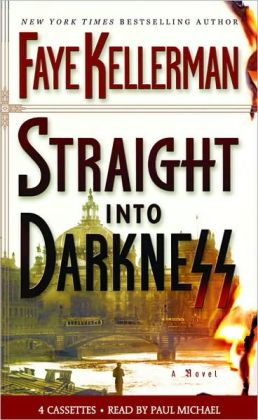
Straight Into Darkness, Faye Kellerman, best known for her Pete Decker/Rina Lazarus series, drops us into this seething atmosphere, just as a serial killer of glamorous women tightens the city's tension to the breaking point. Her protagonist, homicide detective Axel Berg, is not a Nazi sympathizer, but he's no hero either.
Kellerman shows how the Nazis used these murders as fuel for their poisonous propaganda against their enemies, especially Jews. Munich's residents, still feeling the sting of their WWI defeat and living a precarious existence in an unstable and depressed economy, are only too ready to explode in an orgy of violence. Kellerman skillfully paints a picture of the conditions that helped nurture Nazism and pivotal moments in the Nazis' ascension to power.
In
A Trace of Smoke, Rebecca Cantrell's Hannah Vogel is a crime reporter in 1931 Berlin when she learns that her beloved brother, Ernst, has been murdered. Ernst was a gay transvestite singer in one of Berlin's many nightclubs. As Hannah quietly investigates, she learns of Ernst's involvement with powerful members of Hitler's Brownshirts––who certainly don't want her nosing around their business. This novel's strength is its evocation of the seedy, dangerous atmosphere of Berlin as the Weimar era crumbles.
Cantrell's followup is
A Night of Long Knives, set in 1934, after the Nazis have taken over and the rivalry between the SA's Brownshirts and the
Schutzstaffel [English translation is Defense Corps] (SS) comes to a head. And the third in the series is 2011's
A Game of Lies, set at the 1936 Summer Olympic Games in Berlin. While I enjoyed
A Trace of Smoke, I've been disappointed by its successors.
A Night of Long Knives was a ludicrously far-fetched chase thriller, while
A Game of Lies read like a painful marriage of espionage and Harlequin romance. Cantrell consistently demonstrates that she has done her historical research, but I find Hannah Vogel's personal story mawkish and uninteresting. The series is popular, though, so don't go by me. Try it for yourself.
Jeffery Deaver, perhaps best known for his Lincoln Rhyme series that started with
The Bone Collector, is also a prolific writer of nonseries books. In his 2004 book,
Garden of Beasts: A Novel of Berlin 1936, Paul Schumann is a mob hitman who must make a deal with the government or be prosecuted for his crimes. The feds want to take advantage of Schumann's fluency with the German language (and as a rub-out artist) to throw a monkey wrench in Germany's remilitarization plans. Schumann's assignment is to eliminate Reinhard Ernst, the talented man responsible for Germany's rearmament program.
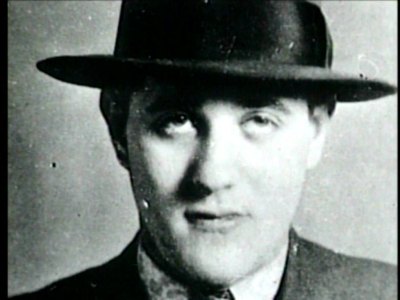
Schumann's cover for his trip to Germany is that he's a journalist going to Berlin for the Olympic Games. Schumann gets into trouble with a German agent immediately, and his local contact kills the agent. This brings police detective Willi Kohl into play, in addition to the Gestapo, and there follows quite a multiple-player cat-and-mouse game as Schumann attempts to complete his murderous assignment. Although the book suffers from uneven pacing and implausibility, and the way Deaver translates well-known German words into English is annoying and distracting (not to mention sometimes downright wrong), he manages to create good dramatic tension and has some nice insights into the characters of ordinary Germans and how they cope with lives radically changed under the menace of the Third Reich.
Garden of Beasts won the 2004 Steel Dagger Award.
"Garden of Beasts" is a loose translation of "Tiergarten," Berlin's celebrated urban park. Erik Larson used the same translation for his recent book of nonfiction,
In the Garden of Beasts. This stellar, novelistic book tells the story of college professor William Dodd, who acted as America's ambassador to Germany for several years from 1933, and his adult daughter, Martha, who came along to live in Berlin. Dodd found conditions under the Nazi fist far worse than he imagined, but was unable to get the hidebound foreign service to act. Meanwhile, Martha was having the time of her life, enthralled with the pageantry of the Stormtroopers and SS, believing in Hitler as the savior of Germany, and more than a little attracted to various Nazis. But Martha then began an affair with a Soviet NKVD agent and began to see the dark side of Nazism. Martha's infatuation with fascism, and then with communism, helps us see in one person the passionate believers each of these belief systems attracted and the collision course they were on throughout Europe in the 1930s.
 |
| Tiergarten |
Reading Manning Coles's Tommy Hambledon espionage books can be a disconcerting experience. Several of the books were written before WW2 or at the beginning of the war; in other words, before the world knew the full horrors of Nazism
. The Nazis in the prewar-written books can be a little like cartoon villains at times. But I hope you'll read
A Toast to Tomorrow, about a man who awakes in a German military hospital with no memory and takes up a new life, becoming an insider in the Nazi party until the day in 1933 when he remembers that he's actually a British spy. Though it has its comic moments, it's a terrific peek into the duality of the life of a spy. A more serious look at the same subject is Manning Coles's first book, the unforgettable
Drink to Yesterday, set at the end of World War I.
In Manning Coles's next book,
They Tell No Tales, Tommy Hambledon is back in England after his adventures in
A Toast to Tomorrow, and investigating the sabotage of ships sailing from Portsmouth. This book is set in 1938, after Prime Minister Neville Chamberlain's "peace in our time" Munich agreement with Hitler. Unlike Mr. Chamberlain, Tommy wasn't fooled by Hitler and knew that "our time" in peace was limited.
Manning Coles was a pseudonym for friends Adelaide Manning and Cyril Coles, the latter of whom was a longtime British intelligence officer who lived in Cologne for much of the between-the-war years. Rue Morgue Press has republished almost half of the Tommy Hambledon series and a couple of Manning Coles's nonseries books.
Spain was something of a dress rehearsal for what Germany would experience after the Nazi rise to power. Rebecca Pawel's four-book series, set in fascist Spain after the Spanish Civil War between the fascist Loyalists and the left-wing Republicans, features Carlos Alonso Tejada y León, an officer in the country's civil guard. War veteran Tejada is a true believer in fascism and a firm anti-Republican. Members of the civil guard, with their tricorn hats, are hated and feared by ordinary citizens––and with good reason. Tejada and his fellow guards are iron-fisted, with no interest in due process of the law.
In the first book in the series, Death of a Nationalist, set in 1939 Madrid, Tejada summarily executes a woman found next to the body of his murdered friend and colleague, but quickly realizes she was not his killer. He is compelled to try to find his friend's real murderer, but must also confront the devastation his killing of the woman has had on those who loved her. At the same time, one of them, her lover, is looking to avenge her death.
Pawel doesn't shy away from difficult realities in these books; from showing how a deeply-held political conviction and a black-and-white point of view can turn a man who is not a psycho or a monster into someone who believes he is doing a sacred duty when he brutalizes or even murders those who don't share his political viewpoint. But, somehow, Pawel manages to make Tejada into something of a sympathetic character. His development as a person and his growing recognition of shades of gray are helped along when he meets and falls in love with Elena Fernández, a schoolteacher who had been on the side of the Republicans in the Civil War.
The later books in the series, Law of Return, The Watcher in the Pine and The Summer Snow take place in the 1940s. All are recommended.
For a more light-hearted series about the Spanish Civil Guard (though set much later), try Delano Ames's four-volume series featuring Juan Llorca:
The Man in the Tricorn Hat,
The Man with Three Jaguars,
The Man with Three Chins and
The Man with Three Passports.
I have to admit that I haven't been much of a fan of Alan Furst's 1930s and World War II-era espionage books, though many consider him the preeminent novelist of World War II-era espionage. I value character development above all and have never felt a connection with his characters. However, I'm going to give him another try in June, when
Mission to Paris is published.
Some of Furst's books set in the gathering storm era are:
Night Soldiers is a book in which a Bulgarian boy becomes a Soviet agent after his father is murdered by fascists in 1934, and is sent by his spymasters to Spain during its civil war;
Dark Star is set in 1937 and concerns a Soviet spy stationed in Paris;
The Foreign Correspondent is set in 1938 Paris and tells the story of Italian anti-fascists living in the city;
The Spies of Warsaw is about––guess what––spies in Warsaw in 1937; and the upcoming
Mission to Paris will send an American film star to 1938 Paris to film a movie, but also to act as an agent of U.S. intelligence operating from the American embassy.
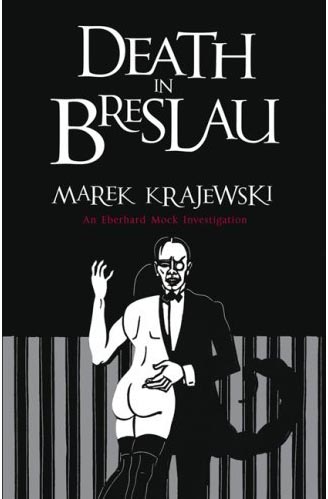
I've barely dipped my toe into Marek Krajewski's noir series set in between-the-wars Breslau, part of the Prussian province of Lower Silesia (now Wrocław, Poland). The series features Eberhard Mock, a dissolute and corrupt police detective who is at home in the city's decadent and seedy precincts. There are six books in the series, three currently available in English and another to come in August. The series begins with
Death In Breslau.
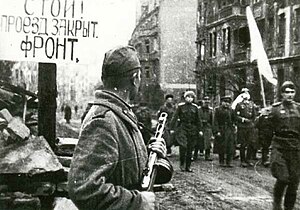
Breslau is a particularly interesting setting for World War II buffs. In the between-the-wars period and during the war, its population was nearly all German and assimilated Jews, with just a tiny percentage of Poles. The city was a stronghold of Nazi sympathizers and almost as soon as the Nazis formally assumed power, the city's Poles and Jews were subject to official persecution. During the war, waves of refugees descended on the city from both the west and east. During the three-month siege by the Russians in 1945, nearly half the city was destroyed and tens of thousands of its residents killed. After the war, the city's ethnic Germans either fled or were forced out. Within just five years, the city's population became overwhelmingly Polish.
Timothy Snyder's nonfictional
Bloodlands: Europe Between Hitler and Stalin is a stunning history of the nightmares visited on the people living in the lands between Russia and Germany. Supreme victims of geography, they were treated as disposable by both occupying authoritarian regimes, sacrificed in service to the ambitions of two madmen.
In his stellar Bernie Gunther series, Philip Kerr uses the smart-mouthed Berlin police-inspector-turned-private-detective to confront the reader with the moral dilemmas and impossible choices facing citizens of a country gone mad, where conventional morality has been subverted to serve a genocidally racist philosophy. Even those who hate the new regime are generally complicit in one way or another. Four books in the Bernie Gunther series are set, at least partially, in the 1930s:
The first book, March Violets, in set in 1936, a few years after Bernie has effectively been forced out of Berlin's Kriminalpolizei as a result of the Nazi takeover and the politicization of the police force. The second in the series, The Pale Criminal, is set two years later, when Bernie is forced by the Gestapo's Reinhard Heydrich to return to the Kripo to investigate the murders of teenage girls.
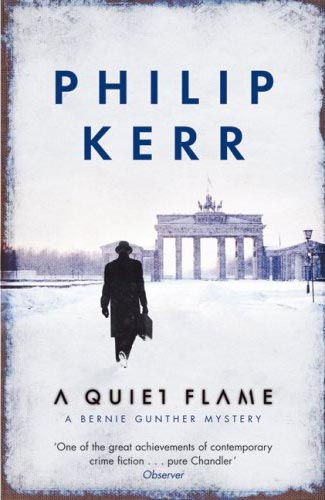 A Quiet Flame
 and
If the Dead Rise Not are dual-narrative stories. One story takes place after the war, with Bernie having fled Germany after the war and living in South America (and, of course, getting into as much trouble there as he managed in Germany). The other narrative in
A Quiet Flame takes us in flashbacks to 1932 Berlin, when Bernie was in the Kripo, investigating two murders that bear disturbing resemblance to murders happening in 1950 Argentina. In
If the Dead Rise Not, the second narrative takes us back to 1934, after Bernie has been forced out of the Kripo and is a house detective at Berlin's famous Adlon Hotel.
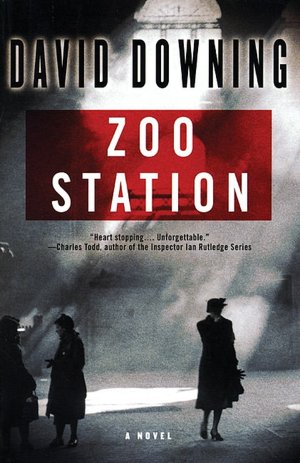
The first two books in David Downing's John Russell series,
Zoo Station and
Silesian Station, take place in Berlin, just before Germany invades Poland in September, 1939. English journalist Russell has lived and worked in Berlin for 15 years. He hates the Nazis, but won't leave Berlin because it's the home of his son from his former marriage and his girlfriend, Effi. His personal life makes him vulnerable to pressure and persuasion from various intelligence services, and he finds himself playing the Russians, British, Americans and Germans off each other in an increasingly risky game.
In future posts about the World War II era, I plan to discuss espionage and crime fiction set in Europe, books set in the U.S. or featuring American protagonists, and books involving time travel or alternative history. I don't have plans to tackle books set in Japan or elsewhere in the Pacific Theater of Operations.
I can't hope to write a comprehensive summary of all the good World War II-era espionage and other crime fiction books, but I hope you'll let me know about other titles you'd recommend, starting here with the between-the-wars period. As we go along, with your help alerting me to other recommended titles, I'd like to develop a bibliography of WW2-era crime fiction.
* * *
Note: Portions of this post are taken from book reviews posted on Amazon under my Amazon user name. I received a free review copy of Philip Kerr's Prague Fatale.