Saturday, March 17, 2012

A Bit O' Blarney for St. Patrick's Day

Georgette Spelvin: Céad Míle Fáilte! St. Patrick's Day is a day when many of us wish we were Irish, not just for an excuse to go pub crawling, but because the Irish are so dang wonderful. Take their music, whether ancient or rock 'n roll, for one thing. How cool is U2's "Beautiful Day"?


Sister Mary Murderous is entertaining houseguests and won't be joining us in this conversation. I think her guests are Irish. Or, maybe they simply know how to party like the Irish while they watch the NCAA March Madness basketball games this weekend. They'll all be wearing green today. Or perhaps just looking green after eating too many of Sister Mary's unbelievable pecan/coconut/caramel cookies.

Maltese Condor: When I began to think about the day designated for the wearing of the green it made me consider my past reading of books that have a little green in them.

In Red, Green, or Murder by Steven Havill, no one would consider Posadas ex-Sheriff Bill Gastner green, and he would rather they didn’t consider him fragile either as he investigates the death of a friend.

Leave the Grave Green, writes Deborah Crombie,
 as she leads Duncan Kincaid and Sgt. Gemma James into a series-long romantic relationship, which leaves many green with envy. They should be keeping their mind on the drowning/murder of a disliked man.

Celia Grant, a professional horticulturist with a green thumb, discovers a dead body under her landscaping in Green Trigger Fingers by John Sherwood. Naturally, she wants to solve this case herself.

The last mystery written by Clyde Clason was Green Shiver 
in 1941, and it revolved about the rarest of green jade.

A wealthy man gets blown to smithereens in W. J. Burley's Wycliffe and the Pea-Green Boat, and the Chief Superintendant has to wonder if the man’s son has a case of the green-eyed monster.

It has been so long since I read Greenmask! by Elizabeth Linington
 that I believe I was green and recycled it.

The Green Plaid Pants is a mystery by Margaret Scherf that revolves around a pair of trousers purported to belong to Bonnie Prince Charlie. Personally, I have seen plenty of these on greens.

Not red, but Green for Danger, writes Christianna Brand in one of her Inspector Cockrill series. The victim actually might have turned a little green at the gills before expiring.

Kerry Greenwood has Phryne Fisher competition dancing for long hours in The Green Mill Murder, and she has to eat her greens to keep her strength up, like Popeye, to solve a case with roots in the Great War.

I can't overlook the perennial favorites Green Eggs and Ham by Dr. Seuss and the song "It's Not Easy Being Green" by Sesame Street's Kermit the Frog. Believe it or not, Kermit wrote a book of the same name.

Della Streetwise: Easier to think of Kermit croaking a song than writing a book with those webbed fingers. MC, all those Green titles make me think of a green Ireland. Lush green grass and shamrocks, legends and myths. Kissing the Blarney Stone. Leprechauns. Irish whiskey, Irish coffee. Irish writers and Irish mysteries. Here are some mysteries set in Ireland:
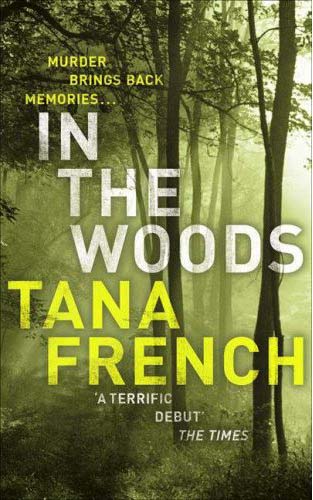
Tana French's debut In the Woods blew my socks off. It didn't give me much of a sense of Dublin, the physical place, but it gave me a distinct sense of the emotional place of yearning and the paths her characters took to arrive there. Yearning for closure of a tragic childhood mystery. Yearning for an everlasting peace. I liked her next two Dublin murder squad books involving some of these characters, The Likeness and Faithful Place. I can't wait for the fourth, Broken Harbor.

In The Wrong Kind of Blood, by Declan Hughes, Ed Loy is a down-on-his-luck private eye in Los Angeles. He returns home to Dublin for his mother's funeral and an old friend hires him to find her missing husband in the first book in this hard-boiled series.

John Brady's long-running series features a sergeant, later an inspector, in the Irish Garda named Matt Minogue. The books are set in Northern Ireland and the plots reflect the tensions there. The first book is A Stone of the Heart, involving the killing of a Trinity College student. My favorite series book is Kaddish in Dublin, in which Minogue investigates the murder of Paul Fine, the son of Chief Justice Fine.

John Banville's Dr. Quirke mysteries contain dazzling writing. They're published under his pen name, Benjamin Black. Quirke, a hard-drinking pathologist, uncovers a mess when he looks into the death of a maid named Christine Falls in 1950s Dublin. The fifth book in this series, Vengeance, is due in August.

Georgette Spelvin: You mentioned some great books, Della. I'll add some more:

St. Patrick's Day can't pass without a mention of Bartholomew Gill's Peter McGarr, a police officer in Dublin. The setting and characters in this Irish police procedural series are very well done. The Death of a Joyce Scholar is must reading for people who visit Dublin, either in person or through the pages of their books. The last in this series is the excellent 2002 book Death in Dublin, in which two illuminated manuscripts from the four-volume Book of Kells are stolen from the library of Trinity College and a security guard is killed.

Detective Inspector Jack Lennon is Stuart Neville's protagonist in a terrific hardboiled series set in Belfast. The Ghosts of Belfast kicks it off by introducing Gerry Fegan, who's just been released from prison. He's troubled by the ghosts of those he killed for the IRA, and he wants to lay them to rest.

Another excellent hardboiled series: Ken Bruen's Jack Taylor books set in Galway, beginning with The Guards. Ann Henderson shoves former Garda Síochána member Jack Taylor off his barstool to investigate the death of her daughter Sarah, called a suicide by the cops, but Ann says no.

Patrick McGinley's 1978 book Bogmail is a beautifully written tale about what having committed a murder does to the murderer. Roarty, the book's main character, is a pub owner who says about his absent daughter's lover, "He must be destroyed," and before too long, he is. The other characters have the habit of dropping in at Roarty's bar for a drink, and it's a pleasure to listen in on their conversations.

I also enjoyed The Third Policeman by Flann O'Brien (a member of The Holy Irish Trinity: James Joyce, Samuel Beckett, and Flann O'Brien). A very bizarre novel, and if you are fond of surreal elements with your mystery, you might like it too. Another great read is O'Brien's At Swim––Two Birds, an inventive comic masterpiece about a lazy college student in Dublin who spends much of his time reading or in bed. This is a Russian nesting doll of a book, in that O'Brien's narrator is himself working on a novel about an author whose characters give him an incredibly hard time.

Paul Murray's 2010 Skippy Dies was long-listed for the Man Booker Prize. It's not a mystery, but a tender and hilarious 670-page novel that begins with a death by doughnut. It's set at an elite all-boys Catholic prep school in Dublin.

Joyce, Beckett, and Flann O'Brien are must-reads. And a couple more not to be missed: William Trevor, who's been nominated for the Booker five times and has won the Whitbread Prize three times (try the lovely Love and Summer), and Roddy Doyle (try his Barrytown Trilogy).

Peri, your thoughts?

Periphera: When you think of an Irish-American celebration for Saint Patrick's Day, what springs to mind? Lush green countryside and parades? Green beer? Philadelphia has all that, but our "Running of the Micks" (yes, that is the name of the event) may be unique. It is an annual bash that includes a bus crawl of ten Irish pubs followed by a Rocky-like run up the Art Museum steps. Many have tried, but few have succeeded. Some participants insist that success depends on the number of green beers consumed beforehand. The only real mystery here is that no participant has ever died or been seriously injured during the event. The city keeps a few ambulances on standby, just in case.
This event has proved so popular that a number of imitators have sprung up. While the center city event relies heavily on draft Guinness, the suburban Craft Beer Bus carries revelers to a number of pubs serving the products of local microbreweries. No exercise, short of getting on and off the bus, is required. And nearby Laurel Hill Cemetery offers a guided moonlight tour of its facilities followed by a beer buffet, in case you are just longing for a good Irish wake. Tomorrow morning, you may wish you were attending your own!


Material Witnesses: To all of you on St. Patrick's Day -- Sláinte!

Wednesday, March 14, 2012

I Spy a Sleeping Spy

Last week my good friend Sister Mary Murderous reviewed Olen Steinhauer's An American Spy. I was in the mood for espionage, but the mental picture of spies chasing through the snow in Prague or standing on a dark cold street in Helsinki made me pause and shiver. How much nicer for a spy to hibernate during the winter and to awaken in the spring when it is warmer.

There's no such thing as a free lunch.
Hibernation may be pleasant for the spy, but it presents the spy's master with obvious potential problems. The goal is for the spy to be comfortable sleeping in enemy territory while disarming the enemy's suspicions, yet the spy shouldn't be so comfortable s/he will refuse to be awakened. The spymaster in Donald E. Westlake's Money for Nothing gets around this problem in an ingenious way. His sleeping spy doesn't realize he's been asleep, or even a spy, until he's told to wake up.

Here's how it happens. Josh Redmont receives a mysterious check for $1,000 from United States Agent. Redmont is a fairly honest guy. He tries to trace the check but he doesn't get anywhere and he could use the money. Whoever United States Agent is, the check is good so Redmont cashes it––then the one he gets the next month, and the next month after that. The checks keep coming for seven years and Redmont keeps cashing them.

Then one day, a stranger introduces himself as United States Agent and tells Redmont that he's active. The threatened safety of Redmont's wife and child will insure Redmont's cooperation in an assassination scheme that is somewhere between a Westlake comic caper and a hard-boiled Westlake-writing-as-Richard-Stark plot. The book's indeterminate nature keeps it from being top-of-the-line Westlake, but it's still an entertaining book about a man who unexpectedly proves to be a more enterprising agent than his spymaster dreamed possible.

Eric Clark's The Sleeper is more serious, ironic and suspenseful than Westlake's book. It invites discussion about gray areas of morality. Clark's protagonist is James Fenn, a young British journalist who is a communist sympathizer like his father. Fenn thinks he knows what he's letting himself in for when he walks out of Hungary in 1956 with a rescued baby strapped to his chest. The escape from Hungary is planned because Fenn is to be Russia's sleeping spy in England. The baby is a "welcome bonus" who is adopted by Joseph Banks, a very rich English academic, and his Hungarian-born wife.

It's now more than 20 years later, in the 1980s. Fenn no longer works on Fleet Street. He, his wife and two young daughters have moved to Malta, where they live simply but happily. Fenn isn't much of a Marxist anymore.

Richard Stanley Godwin, former Defence Minister, has just been elected British prime minister. In West Germany, the CIA has been questioning Vitali Suslov, but the Americans can't decide whether he's a genuine defector or a KGB plant. Based on what Suslov says, someone in England has passed secret information to the Russians. The CIA suspects Godwin's good friend and adviser, Sir Joseph Banks.

The CIA insists that the British investigate Banks, but there's a big problem. Several years earlier, British Intelligence tried to investigate Banks and when Defence Minister Godwin got wind of it, he was outraged and put a stop to it. Now, the investigation will have to be done without Prime Minister Godwin's knowledge. An elaborate plan is devised that involves Fenn, the journalist with a special connection to Banks through Banks's adopted daughter. The British know Fenn is a never-awakened Soviet spy, so a British agent named Mallahide will pretend to be the Russian spymaster who tells Fenn it is time to wake up.

The ensuing scheme involving the manipulation of Fenn and the targeting of Banks is more complex than it needs to be. This makes it less believable, but its complexity makes it noteworthy and worthy of Machiavelli. As the screw comes down hard, the plot twists and turns and the tension mounts to the almost unbearable point. Mallahide pops more and more aspirin and Fenn sleeps less and less until the book's conclusion, when the reader can finally put the book down and sleep.

That is, unless the reader needs another book with a sleeping spy, such as the following: William Safire's Sleeper Spy features a Russian spy who has earned a fortune in the U.S. through his investment of Russian money. The Russians have forgotten exactly who he is, but they––and the Americans––want to hunt him down. There is a race to identify an Oxford-educated IRA sleeper agent in former Director General of MI5 Stella Rimington's thriller, Secret Asset. Michael Gilbert's Into Battle is set on the eve of World War I, while Daniel Silva's The Unlikely Spy is set in World War II. In Manning Coles' second Tommy Hambledon book, A Toast to Tomorrow, a man with amnesia is released from the hospital and becomes an important person in the Nazi party before he remembers that he's a British spy. Now that's what I call hibernation!

Monday, March 12, 2012

To Eat or Not To Eat

Traditionally, Lent is a time of fasting and repentance that is commonly practiced by giving up a favorite food or habit. When I think of this behavior, I always have the image in my mind of the mayor of the little French town in which Vianne Rocher opened a chocolate shop just across from the church during the weeks before Easter in the movie Chocolat. In my mind's eye I can see the suffering man eating his measly dinner, then finally caving in and almost drowning himself in chocolate in the store window. Giving up a little food would be a good thing for me in many ways, and if I did this incredible thing I would also have to avoid reading books about delicious cooking.

The Cooking School Murders and The Baked Bean Supper Murders by Virginia Rich were the first books I remember reading with recipes in the back. This was back in the early 1980s. A decade later I found Tamar Myers's Pennsylvania Dutch series that featured Magdalena Yoder, the owner of a Mennonite inn in Hernia, Pennsylvania. She made me laugh when she said that she came from a family with so much intermarriage that she was probably her own aunt, niece or cousin and could have a family picnic if she went outside to eat all by herself. I did try one or two of the recipes that Myers included in her early books, but they all failed dismally. The one I wanted to succeed most was a form of chocolate pie.

Spaghetti in Ink
It is always intriguing to read about the food my favorite protagonists eat and some of it would be perfect Lenten fare because I would have no trouble passing it up. Andrea Camilleri's Salvo Montalbano loves his seafood but I would give his pasta with squid ink a pass. He always names his dinners in Italian which I always look up, sometimes to my dismay.

On the other hand, Arnaldur Indridason's Erlendur Sveinsson loves his boiled sheep's head, which I initially took for a cauliflower dish, but the real thing is quite popular in Iceland. Yes, put that on my menu for Lent.

Gerald Samper, in the book Cooking With Fernet Branca by James Hamilton-Paterson, declares that a good dish must remind us that the world is an unexpected place full of unfamiliar challenges. Some of his recipes include kidneys in toffee, lychees on toast with peanut butter and hard cheese, and any animal or other creature you might see in your back yard skinned and eaten with a mixture of a variety of fruits and veggies, some of which should be getting old and possibly maggot-ridden. For the extra flavor and protein, you know. These recipes would put me on a starvation diet and it would be so great for my body and soul.

The most curious cuisine that I have come across in my reading was in the book Red Mandarin Dress by Qiu Xiaolong. I knew that food is an important aspect of Chinese life, but what I learned in this novel was that sometimes people ate certain foods to produce certain moods and to reinforce the power in their life.

Mandarin Dress
In this story, a young woman has been found on the safety island in the middle of a busy Shanghai road. She was wearing a red mandarin dress made a few decades past. Police Inspector Chen Cao is engaged on a case of real estate corruption and, at the same time, he is trying to pursue his literature studies. The case is turned over to Detective Yu Guangming, who is Chen’s partner. Everybody is startled when a second young woman is found dumped and displayed in a similar fashion. A serial killer is the first one of his kind in Shanghai, and the public is stirred by the loss of two women in their flowering age. Chen must put his mind back on the job at hand, and a friend arranges a meal at a special restaurant that he will share with several successful men.

This unusual dinner that Chen Cao was invited to in order get him on the right path was a cruel food experience. This was a multi-course meal that took several hours. The menu included fried sparrow tongues followed by live caged monkey brains. The diners apparently enjoy the live brain fresh and bloody. The live caged monkey with shaven head was brought to the table. There was also live shrimp in wine. In this dish the shrimp become intoxicated as they swim in the wine. They are fried alive at the table and they hop about on the skillet. There are a few more dishes in this vein, but these few choices are also enough to put us off food for a while.

Drunken Shrimp
This is the best of the Inspector Chen series so far in my reading of the series. Chen's approach to solving this case has less to do with forensics and more with history. This version of traditional Chinese dress that originated in the mid 1600s was created in the 1920s, restyled from the original baggy outfit for courtesans and celebrities.

For those of you who have chosen to give up a favorite thing for Lent, I hope it wasn't reading. Whatever you are denying yourself, hang in there. Before you know it, the 40 days of penance will be over and menus can return to comfort food and satiety.

Friday, March 9, 2012

Book Review of Olen Steinhauer's An American Spy

An American Spy by Olen Steinhauer

The Cold War era was the heyday of the spy novel. The bad guys were Soviets or East Germans, and the action involved gray men in gray cities behind the Iron Curtain. When the Cold War ended, some thought that would mean the demise of the spy novel, but they were wrong. There will always be the "other," an enemy to hate and fear. Today, we have terrorists of various stripes, of course, but we also have a new bogeyman in town, and he's Chinese. As well as a change in adversary, modern spy fiction reflects other global developments. The conspiracies these days are worldwide, with each side forming shifting alliances with armies, terrorists, self-styled freedom fighters and tribes from every hotspot on the globe. Spies jet from New York to London to Geneva to Hong Kong and dozens of other locales, using all the latest technologies to try to outmaneuver each other.

An American Spy is as cynical as any Cold War novel, and at least as full of double- and triple-crosses. Milo Weaver, a former "Tourist" with the CIA, is recovering from a gunshot wound to the gut and the obliteration of his department, both orchestrated by Xin Zhu, an operative with China's security service. Milo wants nothing more than to make his exit from the spy business permanent, to join the civilian life and to be a regular husband to his wife, Tina, and father to his stepdaughter, Stephanie. But Alan Drummond, Milo's old boss, is determined to exact revenge on Xin Zhu, and he drags Milo into his scheme.

At the same time, Xin Zhu is threatened by more than Alan's scheme, as he finds himself––and, possibly, his beloved wife––the target of another plot by hidden enemies within his own security service. Milo will find himself and his family caught in the middle when Alan's scheme and the Chinese plot come together.

Here's where you notice a more subtle difference between Cold War spy fiction and Olen Steinhauer's Milo Weaver series. In the former, the operatives are usually lone wolves, with their personal relationships tending to be fleeting or emotionally barren. In An American Spy, family relationships are preeminent, not just to Milo, but to Alan, to Xin Zhu and to several secondary characters. The need to protect the family or to avenge harm done to family members forms the motive for much of the plot. It adds a different dimension to the spy story.

This is the third volume in the Milo Weaver series, following The Tourist and The Nearest Exit.  While this book can be read as a standalone, I don't recommend it. Almost 100 pages of the book go by before Milo Weaver even appears on the scene, and if you don't already know who Xin Zhu, Erika Schwartz and Letitia Jones are, you could be excused for wondering what they have to do with Milo and why the book seems to be about them. And even when Milo does make his appearance, he may seem to be largely passive––not surprising, considering he is a reluctant player in the game.

The plot is slow to draw the reader into its web, the pace quickening only in the last quarter of the book. This may not be satisfying to a reader who is unfamiliar with the prior books in the series or to one who is more thriller-oriented. This is a spy story, not a thriller. It's about the machinations of the characters; figuring out their hidden meanings and motivations and how all the pieces of the puzzle fit together. And, most of all, it's about a couple of enemies, Milo Weaver and Xin Zhu, who have an unspoken understanding of each other, and a sad and hard-earned knowledge of the price their professions exact on them and their families. This is a rewarding read for someone who has an interest in that more personal kind of spy story and the patience to follow an intricate and deliberately-paced plot.

Before Olen Steinhauer wrote the Milo Weaver books, he wrote a terrific espionage series about a fictional Communist country at the end of the Cold War era. In addition to the Milo Weaver books, I highly recommend that series. Here are the books in that series, in publication-date order: The Bridge of Sighs, The Confession, 36 Yalta Boulevard, Liberation Movements and Victory Square.


Note: I received a free review copy of An American Spy, and a version of this review appears on the Amazon product page under my Amazon username.

Wednesday, March 7, 2012

How Would You Write a Mystery?

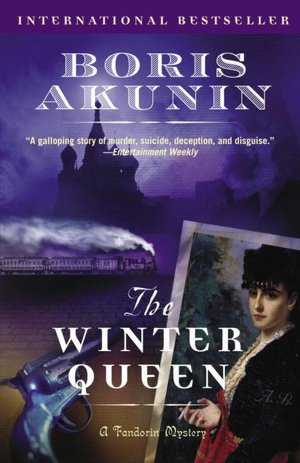
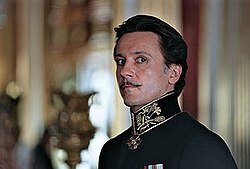
I am participating in a lively online discussion of author Boris Akunin's The Winter Queen. The first in a series of 16 books featuring his protagonist, Erast Fandorin, it is a runaway international best seller set in late 19th-century Czarist Russia. It is a very unusual book, a slyly sarcastic melodrama with cliffhangers at the end of every chapter. You can all but hear the pianist pounding out the danger music as a silent movie unrolls.

I was at a loss to imagine what would persuade a contemporary respected critic and essayist to write such a fantastically unlikely book, until a poster pointed out a fascinating interview with the author in The San Diego Reader.
Interviewer: "Can you describe the '90s––when Russia experienced mass culture for the first time and everything was lawless and open?"

Akunin: "Speaking about the book market, in the first wave the translations were of American hardcore crime fiction and all those books for housewives. This sort of down-market, commercial reading... Then the second wave was when our Russian authors started to write by themselves, and it was even worse. Because they were not professional. They thought the more blood, the more sex, the better. So it went in waves, one after another. The third one started with Alexandra Marinina, which was a decent wave of a decent level. Intelligentsia started to read it and enjoy it––a psychological detective, without all that filth."
Akunin has said elsewhere that his wife is an avid reader of mystery novels, but was so embarrassed by the poor quality and inflammatory cover art that she wrapped them in brown paper covers (as some readers of erotica do here). Akunin studied what was available in the genre and decided that he could do better. He then set about the task in a methodical way, very different to how I imagine most novelists proceed.
"Why sixteen books in the Fandorin series?"
"For two reasons. One is that I counted 16 subgenres of crime novel. And each of my Fandorin books represents a different subgenre. Another is that I counted 16 types of human characters in the world. And each of those books is addressing one of those psychological types." (Emphasis mine)
The Winter Queen is Akunin's Conspiracy subgenre novel. He has obligingly provided a table listing each book in the series and the subgenre it represents here. We went back and forth on the forum about what the 16 character types might be. I think this list of character types would be most useful to a first-time novelist. All but the last two novels have now been translated into English, so playing "spot the characters" might be fun.

But isn't this a bizarre way to write a novel? Like a Chinese menu: select story type A from here and major character B from there, blend well, add some snarky humor and voila! Don't authors sweat and strain over their novels, putting in a huge emotional investment that leaves many of them very sensitive to criticism? What does Akunin say?
Interviewer: "You have said that you don't write from the heart. That you don't have a serious literary soul. That you write with your brain only. What do you mean?"

Akunin: "I mean that I am not an exhibitionist."

"Actually, the only writer, really big writer, who is not an exhibitionist is Nabokov. And still I am not sure of that. Myself, I do not want to talk about my inner problems. My readers have enough problems of their own. I want them to forget their problems. I do not write for myself, like a real writer would. I write for an audience. And if I don't have readers, then I won't write. I have a lot of friends who are real writers and actually they do not care. They want their books to sell, but if no one bought their books, they would continue writing."
There you have it. A methodical, almost scientific approach to the art of writing a best-selling mystery novel. Of course it doesn't hurt if you are also fluent and well-read in several languages, have a subtle but wicked sense of humor, and want to spare your spouse the embarrassment of reading books in plain brown wrappers.

Given the author's tables of mystery and character types, what mystery would you write?

Monday, March 5, 2012

Riding into the English Sunset

Tyrannosaurus rex and Detective Chief Inspector Charlie Woodend are forever linked in my mind. Why? A few days ago, I was idly reading online when I came across an article about the bite of a T. rex. Researchers from the University of Liverpool, using life-size models and computer analysis, state that "the biting force of T. rex may have been able to deliver 12,800 pounds of force—almost 20 times more powerful than previously thought." They likened the force to what it would feel like if an elephant sat down on you.

This is food for thought all right, but what does this have to do with DCI Woodend? Give me a minute. I was still thinking about how much faster I'd need to run from a T. rex than I'd already planned when I started the twentieth book in Sally Spencer's series, Fatal Quest: Woodend's First Case. The story begins in London on the smoggy night of November 10, 1950, when a teenage girl is killed by a man wielding an old-fashioned razor. Then the scene shifts to the buffet at the Whitebridge railway station in June 1973, where a "big bugger in a hairy sports coat" buys a beautiful blonde in her 30s a drink.

The man is newly retired DCI Woodend, and the woman is Sergeant Monika Paniatowski, who will replace him. They have sneaked away from his retirement party. Woodend is waiting for the train that will take him to his retirement villa in Spain. Paniatowski is already missing him; he has been her boss and mentor, and she's dreading his retirement. She teases that it's a miracle he actually made it to retirement, and Woodend smiles and says that's less remarkable than his promotion to Chief Inspector in the first place. He says he did it "by arrangin' to have somebody killed." She asks him to tell her about it, so he does.

In 1945, Major Cathcart, Woodend's WWII commanding officer, told Woodend that he would be returning to his former job at the Metropolitan Police Force and suggested a man of Woodend's obvious abilities should move to London and become a bobby. That explains why Detective Sergeant Woodend is sitting in his office at the Met on November 10, 1950 when the call comes in. A woman's shriek, "delivered in a whisper," tells Woodend that a man told her he had killed a girl and left her body at a bomb site on Mitre Road. Then she hangs up.

At the crime scene, Woodend is disgusted by the language the doctor and the constable use to refer to the murdered girl, who is black. They suggest that the murder will be low in priority for the Met, and their predictions are fulfilled and more. First, Woodend's superior, a lazy and irascible DCI named Bentley, assigns him to head this investigation, a first for Woodend. Then, an anonymous call to Woodend's home warns him that "if yer know what's good for yer, yer won't do that job too thoroughly." Woodend's investigations yield some surprising facts about the murdered girl, Pearl Jones; when Woodend reports these facts to DCI Bentley, he yanks Woodend from the case and assigns him to the death of a criminal at the rough Waterman's Arms.

Woodend is a "decent, honest, principled bloke in a world that has largely given up being decent and principled" and he asks himself, if he doesn't find justice for Pearl, who will? Despite threats from his superiors and London gangsters, attempted bribes, and other attempts to divert him, Woodend perseveres in this case that launches him into the ranks of Detective Chief Inspector. What follows this case is a career of 25 years of crime solving. The Met may not have appreciated the unorthodox Woodend's refusal to play by anyone's rules other than his own, and his talent for getting up his superiors' noses in record time, but Woodend can be proud at his retirement.

Fatal Quest, the last in the series, but detailing Woodend's first case, is a well-written English police procedural, full of wonderful characterizations and ironic humor (Woodend's wife refers to his "sweatin' over a hot criminal all day" when he arrives home). It's more than a simple story of how Woodend tracks down a murderer and becomes a DCI. It's a look at love in its many different forms and the heartache and havoc it can cause. It's a depiction of London five years after the war when bombed-out sites remain and people are scrabbling. The black market opened up new ways for criminals to make a living. Overt racism and corruption stain the Met, and some Met officers argue that organized crime is beneficial because powerful gangsters help keep crime under control. Against this backdrop, it's good to watch the decent Woodend work his first case. Then, in the first book of the series, 1998's The Salton Killings, Diane Thorburn is only the latest in a series of schoolgirls to be killed in 1950s Cheshire, and DCI Woodend will investigate. There are 18 books between these two.

I've already said goodbye to Colin Dexter's Chief Inspector Morse (The Remorseful Day), Ian Rankin's John Rebus (Exit Music), and Henning Mankell's Kurt Wallander (The Troubled Man). There will be no more fantastic Superintendent Andrew Dalziel/Sergeant Peter Pascoe books from Reginald Hill. Happily, Woodend's successor, DCI Monika Paniatowski, now has her own series (beginning with The Dead Hand of History), but I'm hoping very hard that Woodend's disappearance at the end of Fatal Quest won't be an extinction like the one suffered by T. rex. Right before he hops on his train, Woodend says that in six months' time, he'll be running a little private detection agency in Spain with his old mate Paco Ruiz, whom we first met in Madrid at the beginning of the Spanish Civil War in James García Woods's A Murder of No Consequence. I certainly hope Woodend is as good as his word.

Friday, March 2, 2012

Awards Season

Now that the Oscars have been handed out, you might think that Awards Season is over. Nope! It's time to start planning for mystery book awards. Do you think you'll have better luck on these awards than in your Oscar pool?


Edgar

The Edgars are awarded by the Mystery Writers of America. This year's awards ceremony will be in New York City on April 26. Here are the nominees for best mystery:

Ace Atkins: The Ranger
Mo Hayder: Gone
Keigo Higashino: The Devotion of Suspect X
Anne Holt: 1222
Philip Kerr: Field Gray

Sister MM: Well, at least I've read one of these: Field Gray. I liked it, but it had a very complex time-hopping plot that I think will keep it from being a serious contender. After Georgette's post on Wednesday, I know I want to read 1222. So, what the heck, I'll pick it as the winner.

Georgette: I've read three of the five: the books by Holt, Kerr, and Higashino. They are so different from each other, I don't know which I'd say should win. One of the things I enjoyed about Holt's 1222 was the author's sense of humor coupled with her protagonist Hanne Wilhelmsen's astringent nature. A great combination. I loved the maneuvering between Higashino's Columbo-like sleuth and his brilliant adversary. Kerr's Bernie Gunther series is excellent, and Field Gray is a solid entry with a good use of settings. Atkins is good at making a reader care about his characters. Hayder is a talented writer who easily comes up with creepy plots and characters. I wrote all of these titles down on pieces of paper and then picked one out of a hat to predict the winner. It's Hayder's Gone. Anybody else want to make a prediction?

Della: Since you already picked a name out of the hat I'll try to figure out the winner in a different way, Georgette. How often has a Japanese book been nominated? I think the judges will decide that Scandinavian mysteries have received a lot of attention in the last few years (think Stieg Larsson, Stieg Larsson, Stieg Larsson) and will choose Keigo Higashino's The Devotion of Suspect X.

Periphera: I have to agree with Della on this one after reading in a review that it "has all the brilliant intricacy of the best Golden Age mysteries." That did it for me.

Maltese Condor: I will throw the dice and put my money on Ace Atkins, because if it is anything like his Nick Travers blues series, it is one I would like to read.

Agatha

The Agathas are awarded for traditional mysteries first published in the US and are given out each year at the Malice Domestic conference in the Washington, D.C. area. This year's awards will be announced on April 28. Here are the current nominees for best novel:

Donna Andrews: The Real Macaw
Krista Davis: The Diva Haunts the House
G. M. Malliet: Wicked Autumn
Margaret Maron: Three-Day Town
Louise Penny: A Trick of the Light

Sister MM: Hey, I read three of these! The last three. The pickings must have been slim this year if Three-Day Town won a nomination. It was not good. Not good at all.

Periphera: I've only read two of the Agatha nominees, Wicked Autumn and A Trick of the Light. While I enjoyed Wicked Autumn very much (even blogged about it), Louise Penny is always a must-read author for me.

Georgette: Well, this is an easy one for me. I've only read one, Penny's A Trick of the Light. I'm a Penny fan, and this book is wonderful. So I'll root for it and pick it to win. I remember your blog about the Malliet book, with its map, Peri. I love maps and wish all books contained them. Maps and a cast of characters list. You cheated, Sister. You didn't predict a winner, and you didn't specify why you didn't like Maron's book. I presume Peri predicts the Penny. And that she does it perilously and, uh, precociously.

Della: Precisely. Did you know that Donna Andrews and Louise Penny have been nominated for five years in a row now and Penny has won the last four years? I think Penny will win this time too.

Sister MM: OK, Georgette, if you want me to say what was wrong with Maron's book, I will. It was the first time she put Deborah Knott and Sigrid Harald together and I was excited about seeing Sigrid Harald again after a 16-year absence. Well, be careful what you wish for. Harald sleepwalked (grumpily) through the book, and Knott came across as a ditz who capped her ditziness with a classic too-stupid-to-live maneuver. Much as I love Louise Penny, I'm going to bet against her here and go with Wicked Autumn. I think the Malice Domestic people will like this revival of the traditional English village mystery, and especially its handsome MI-5-agent-turned-vicar protagonist.

Periphera: Oh no Della, for Louise Penny to win five years in a row seems ostentatious. I'll change my mind and root for Wicked Autumn to give someone else a look-in.

Maltese Condor: I consider myself fortunate to have all these books to look forward to. Donna Andrews is also up for a Lefty Award (given by Left Coast Crime), which is awarded to the best humorous mystery of the year. On the Lefty list, I can comment on Rita Lakin's Getting Old Can Kill You, because at present I am reading it and enjoying it completely. As for a winner, I'll put Penny in the lead because if I had to compare Andrews, who writes about things caroming along at a frenetic pace, and Louise Penny's calmer delivery, sanity will always prevail against insanity.

Anthony

The Anthony's are handed out each fall at the Bouchercon mystery conference. This year's Bouchercon will take place in Cleveland from October 4-7. Anthony nominees will be announced after April 30.

Dilys

The Dilys Awards are given by the Independent Mystery Booksellers Association. This year's award will be handed out on March 31. Here are the current nominees:

Tim Dorsey: When Elves Attack
G. M. Malliet: Wicked Autumn
Archer Mayor: Tag Man
Louise Penny: A Trick of the Light
S. J. Rozan: Ghost Hero

Sister MM: I've read the Louise Penny and G. M. Malliet and would recommend both of them. This award is supposed to go to the book that independent mystery booksellers most enjoyed selling. I'll bet that was Wicked Autumn.

Georgette: I've read other books by Dorsey, Mayor, and Rozan, but not these. I haven't read the Malliet. I've already predicted that this Penny book will win the Agatha, so I won't predict it to win the Dilys. I doubt the Dorsey will win because it's set at Christmas, and I don't think the IMBA will choose a Christmas book. I'm hoping the Mayor book will win because I love quirky Brattleboro, Vermont, the setting of Mayor's Joe Gunther police procedurals, and I want an excuse to read Tag Man.

Della: Dorsey's books are of the nutty Floridian school of mystery. I enjoy them, but I think the booksellers will go for something more serious. I'm predicting the Rozan book, Ghost Hero. Either of those words in the title would make me forecast it for the winner. It feels like a Rozan year. Don't ask me why. I don't know.

Periphera: I can only vote on titles here, and the complete title of the first nominee listed is When Elves Attack: A Joyous Christmas Greeting from the Criminal Nutbars of the Sunshine State. With such a dilly of a title, how can it not win a Dilys? Besides, all those customers trying to remember the title must really amuse booksellers.

Maltese Condor: If I could take only one of these into a waiting room where others are busy reading one of Ken Follet's megabooks (long wait), I would pick Wicked Autumn.

Dagger

The (international) Crime Writers Association has been giving out the prestigious Dagger awards for 56 years. Various Dagger awards are given out in the summer and fall. Nominees for this year's awards haven't yet been announced. Just to show how seriously the Brits take their mysteries, some of the Dagger award ceremonies are even televised!

Periphera: D'ja know? CWA was founded in 1953 by author John Creasey, who wrote over 600 mysteries under 28 known aliases. He once said that even he couldn't remember all his pseudonyms and books!

Georgette: My head is spinning! How did he find the time to found the CWA when he was writing those HUNDREDS of mysteries? Was the man human? Even if he'd only written his books featuring the Toff or the George Gideon books (as J. J. Marric), he'd have had reason to be proud.

Della: Creasey makes me feel like a layabout. He must define the word workaholic or at least writeaholic. He didn't even use a computer. His publisher must have employed a whole herd of editors just for him. According to Wikipedia, romance writer Barbara Cartland published even more books: 722. I haven't read a single one. I was just looking at the 2010 Dagger Awards and saw that Mo Hayder's Gone was nominated for a Steel Dagger. How is it now nominated for a 2011 Edgar?

Sister MM: I know the answer to that one. Gone was first published in the US in 2011, so it's just now eligible for an Edgar. The first UK edition was published in February 2010, and the Steel Dagger awarded in 2010 considered books first published in the UK from June 1, 2009 through May 31, 2010. By the way, one of my favorite bloggers, Karen from Euro Crime, keeps a running list of all books that meet the publishing criteria for Dagger consideration. If you want to see the current list, you can find it here: International Dagger Speculation (2012).

Maltese Condor: One 2012 Dagger award has been bestowed on an excellent author. The prestigious Diamond Dagger lifetime achievement award has been given to thriller writer Frederick Forsyth. My favorites of his are The Day of the Jackal, which was his first, and The Odessa File.

Check out the Stop, You're Killing Me! site for a complete list of mystery book awards.