Wednesday, March 13, 2013

The Ides of March

The Ides of March are upon us, to misquote the Bard, William Shakespeare. It was the time when one of the most famous murders of all time took place in Rome. On March 15 in 44 BC, Julius Caesar was stabbed to death at a meeting of the Senate. The Romans did not number days of a month in order from the first through the last day. Rather, they counted back from three fixed points of the month: the Nones (5th or 7th, depending on the length of the month), the Ides (13th or 15th), and the Kalends (1st) of the following month. The Ides occurred near the midpoint of the month, and in March it is the 15th.

Brutus, Cassius and others, urged on by as many as 60 conspirators, committed the dastardly deed.  Their motive was disillusionment over the path Rome was taking. Although Brutus was Caesar's close friend, he felt that Caesar had become a tyrant who was a danger to the Republic.

Disillusionment has been the driving force behind many a fictional hero as well. In The Eye of Jade, by Diane Wei Liang, we are introduced to Mei Wang, a PI in Beijing.

Private detectives are banned in China, but Mei Wang, who once had a stable job in the Ministry of Public Security, thought that there was a need for the services she could provide. In Beijing there are many small crimes that the police will not involve themselves with, and in the new millennium, divorce is becoming more commonplace; factors that allowed Mei to find independence as a businesswoman. All she had to do was market herself as an Information Consultant.

One of Mei Wang's earliest memories is of her life in a labor camp with her father, an intellectual and idealist condemned to hard labor for the rest of his life. One day, her mother came and took her away. She would never see her father again.

She lived a hardscrabble life with her mother, Ling Bai, who struggled to put food on the table for Mei and her younger sister, Lu. Later, Mei Wang went to university, after which she got a job––and an apartment that went with it––at the Ministry of Public Security, a higher echelon of the police department akin to Scotland Yard.

She became disillusioned with her work at the MPS and left there, although her family was aghast at her decision to leave the security of a government job and all the perks that went with it. Her mother felt she was throwing away her future; what mattered in China was not money, but power.

One day, a Mr. Chen Jitian made an appointment to see her. She knew him better as Uncle Chen, a great friend of her mother's. He told a story that began in the winter of 1968, when the Red Guard was terrorizing the country. These roving bands of "patriots" invaded homes and stores. They even ransacked museums, destroying relics and burning everything by building great bonfires and feeding them with all the artwork, documents and records.

Jade Seal
Now, in the present, some of these artifacts are surfacing. It appears that someone had stolen some things before everything was destroyed. Most notably, an ancient ceremonial bowl was found to have been sold to an antique dealer. Uncle Chen is looking for a jade seal he thinks was taken from a museum at the same time as the bowl and asks Mei to find it for him. When Mei finds the person who sold the bowl, she finds a dead body. Now the game is afoot, and Mei backtracks through recent history to find the connections that will lead her to the stolen artifacts––as well as to a new understanding of her own past.

Mei is enterprising and energetic as she pursues the jade seal's journey through the years, but she is conflicted about what she also discovers about her own past life. It takes an illness in a loved one for her to try to reconnect some of the fractured pictures of what really happened to her family.

This is an interesting book that is the start of a series, and I recommend it to all who like stories with a backdrop of history and a fascinating locale.

Donna Leon's Friends in High Places begins on a Saturday at this time of year. While lolling on his sofa and reading about ancient Persia, Guido Brunetti, a Commissario of the Venice police, gets a visit from a bureaucrat in charge of finding and recording changes made to historical buildings. The Brunetti apartment appears not to exist, according to the paperwork, and this is just the first conundrum to be solved in this ninth mystery of the excellent series by Leon.

A few months later, Brunetti receives a call from the same man, Franco Rossi. He is asking for help, but before he can make his problem known he is found dead in such as way to suggest an accident. Brunetti knows better.

A side story is the problem with the drug scene that is now appearing, and involves Brunetti's boss's son. Brunetti knows that this boy should be punished and wants to conduct a proper investigation, but he is aware that he would be signing his death warrant if he proceeds.

Brunetti asks himself and his wife to speculate on how they have both changed since they were young college students, when they were liberal and wanted to change the world. Now they are both increasingly disillusioned about how they adapt to the way things are and always have been in Venice.

This book is worth reading because of the strong writing of the highest order, and the way the lives of Brunetti, his wife and children are a part of the plot itself. All of us have to compromise to live in this world, and to do the next right thing is the challenge. Brunetti does this well.

Disillusion is not a stranger behind the Iron Curtain, and it walks hand in hand with Arkady Renko in Red Square, by Martin Cruz Smith.

Red Square is set in Russia in the year 1991. It is a sequel to Gorky Park and Polar Star and features Investigator Arkady Renko at the time of the collapse of the Soviet Union.

As the social and economic structures of the Soviet Union break down, Arkady Renko has been reinstated as an Investigator in the police force. He is trying to clear up a nest of illicit traders when his chief informant dies in a horrific fireball. At the late informer's flat, his fax machine keeps asking the apparently meaningless question, "Where is Red Square?"

The question does not pertain to a location, but to a painting by Kazimir Malevich, which has resurfaced on the black market after being lost since World War II.

Smith has created a remarkable character in his redoubtable Russian policeman Arkady Renko, the rejected son of a famous Russian military officer who became a brutal wartime hero of the Communist Party. Renko is a brilliant investigator with a skeptical and independent point of view. Having earlier sacrificed himself for his dissident lover, Irina Asanova, suffering imprisonment and exile for helping her escape, he returns to Moscow on the brink of political and social dissolution. It appears that corrupt officials and black marketers run the country, while organized crime has replaced the Party as the controlling force in Russian society.

Smith brings all of these elements together in this story, which covers two weeks in August 1991, a time leading up to the attempted coup of August 21, in which right-wing elements intended to wrest control from reformist President Mikhail Gorbachev. There is an informative backstory describing the history of the Chechens and their relationship with Russia. The suicide of Renko's father brings a personal note to the chronicle.

The trail of Renko's murder investigation leads both to the Russian mafia and to criminal connections in Munich. Renko has been listening to Radio Liberty on a borrowed radio and has heard Irina's voice. When circumstances seem to fit, he gets himself to Munich and finds Irina. Renko finds that his perceived duty to his homeland conflicts with his personal desires; that by solving the case (which has now cost the life of a fellow investigator), he may again lose Irina.

Although the plot of this detective novel is complex and carefully constructed, Smith's primary interest is in the character development of his subtle protagonist. Renko is a tormented hero, a man of conscience. Revenge for the death of his informant and for other deaths sits quietly on his mind as well. Smith's portrayal of Renko's navigation through a collapsing world is compelling and draws one into the empty stores of Moscow, the endless lines, and into the lives of the suffering Muscovites.

The biggest mystery to me is why this painting––of which there are apparently two versions––is worth five million dollars. Who can say what it is supposedly valued at today?

All those years ago, it is said that Caesar was handed a warning note as he entered the Senate that day but did not read it. After he entered the hall, Senators holding daggers surrounded Caesar. Casca struck the first blow, hitting Caesar in the neck and drawing blood. The other Senators all joined in, stabbing him repeatedly about the head. Brutus struck a low blow and wounded Caesar in the groin, and Caesar is said to have remarked in Greek, "You, too, my child?" For some reason, today the quote is delivered in Latin as "Et tu, Brute?"

In the end, no purpose was served and the Republic collapsed in civil war and the era of the Roman Empire began. Disillusionment indeed.

Note: I have reviewed or will post reviews of some of these books on Amazon, Goodreads and other sites under my user names there.

Monday, March 11, 2013

Review of Owen Laukkanen's Criminal Enterprise

Criminal Enterprise by Owen Laukkanen

Maybe you're familiar with "Minnesota nice," the stereotypical well-mannered behavior of people born and raised in the state of Minnesota. It means you're self-deprecating. You do polite things like taking at least an hour to say goodbye and refusing offered food three times before accepting it even if you're half-dead starved. You avoid fuss and confrontation.

Owen Laukkanen
Canadians have their own stereotypical behavior, which combines well with that of Minnesotans. I can picture the talented Canadian writer Owen Laukkanen climbing off his moose after a snowy morning ride and eating pancakes hosed with maple syrup before sitting down and wrestling with his own Canadian niceness in order to write about crime. Then Laukkanen can wrench his middle-aged Minnesota BCA Agent Kirk Stevens away from his home––where he makes nice with his legal-aid lawyer wife Nancy and their kids––to team him up with beautiful young FBI Special Agent Carla Windermere, a high-octane workaholic who fishtailed her car into Minneapolis-Saint Paul from Miami.

In Laukkanen's terrific 2012 debut, The Professionals (see review here), Stevens and Windermere collaborate on a well-publicized case––the Pender gang's multi-state kidnapping spree. Criminal Enterprise begins a year later. Stevens has promised Nancy he'll do no more cowboying and is working cold BCA cases. He's trying to convince himself that the sense of accomplishment from solving one matches the thrill of working with Windermere, but he's not succeeding. While Stevens pursues an old case involving a murdered man and his missing wife, Windermere is longing for the competent, easy-going Stevens. Her current FBI partner, Bob Doughty, pulls rank and tosses a wet blanket over her attempts to solve the armed bank robbery on "Eat Street" in Minneapolis.

The bank was robbed by a ski-masked couple: a woman carrying a sawed-off shotgun and a blue-eyed man who brandished an assault rifle. The man cruelly pretended to shoot a teller before he and his partner leaped into a waiting Toyota Camry and were driven away. Your typical bank robbers tend to be amateurs or impulsive degenerates; the Eat Street robbers' weapons and behavior lead Windermere to believe they could be pros.  She begins to examine previous open-case robberies to see if she can detect a pattern and identify a suspect.

On the surface, Carter Tomlin looks like a bad bet for bank robbery. Tomlin is an accountant who lives with his wife Becca and kids in a big Victorian on Summit Avenue, the luxurious Saint Paul neighborhood in which Sinclair Lewis and F. Scott Fitzgerald once lived. Tomlin over-leveraged himself to buy into the American dream, and when he is laid off from the job he's held for 20 years, it's a catastrophe. Tomlin has always believed a man provides for his family. In times of adversity, real men don't complain, they deal with it.

Tomlin deals with it by free-lance accounting and burning through savings. Desperate, he walks into the bank to talk to a loan officer, but then Tomlin has an epiphany. He walks out, buys a cheap disguise at the Walmart next door, and robs the bank instead. The take isn't much so Tomlin obtains some weapons, picks up a couple of partners, and tackles bigger targets. And, guess what? He doesn't feel emasculated any more. In fact, Tomlin feels like a god when he's holding a gun, and he begins to live for the adrenaline rush of committing crime. What do they say about addicts? They require increasingly higher-dose fixes.

Before you dismiss Tomlin as a completely unbelievable character, think about what criminologist Richard Wright, who wrote Armed Robbers in Action, says about self-reinforcing behavior: "Once somebody takes an action, in this case a shootout, then you're off and running. After that events take on a logic of their own, especially when you have these self-enclosed systems of self-reinforcing behavior. None of them make sense except in relation to one another."

This high-voltage thriller practically deserves a warning label on its cover. What with watching Tomlin befriending Stevens, Windermere trying to get the goods on Tomlin, a guy with a personal beef tracking Tomlin, Tomlin turning into a bad-ass criminal who makes ever-crazier decisions; and wondering whether Tomlin's partners in crime, Tricia Henderson and Dragan Medic, can be trusted––I'm not kidding, at one point I found my butt hovering a few inches above the chair, I was that amped up. Take your heart or high-blood pressure medication before you read Criminal Enterprise.

Oh, but before you do, don't neglect to read The Professionals first. It's not necessary to understand Criminal Enterprise, but do it because these books are so much fun. They look at issues such as the toll of juggling personal and professional lives, the impact of an economic downturn, the strain of leading a double life, and relationships between men and women and between parents and their children. There's an interesting chemistry between Stevens, a good cop and family man, and Windermere, a glamorous and gutsy FBI special agent. In addition, the writing is so crisp you can almost hear it crunch between your teeth, and the action builds to a jaws-clenching finish. Don't take my word for it. Pretend you're from Minnesota or Canada and be nice to yourself by reading Laukkanen.

Note: I received a free advance review copy of Criminal Enterprise. It will be published on March 21, 2013 by G. P. Putnam's Sons. I'm thrilled to learn that Laukkanen is now at work on his third Stevens/Windermere book.

Friday, March 8, 2013

What Goes Up Comes Down

Miami in March was my destination for several days of professional continuing education, and I had been following the 80° temperature closely on my weather app. I felt confident I could pack my bathing suit, because our hotel had at least four swimming pools. Hah!

The day after we arrived, the morning temp was 44° F. There was no sunshine, so none of us could be distracted from the primary purpose of our trip.

Aside from the drop in temperature, Miami had a lot to appreciate. The first thing I noted was the ubiquitous Miami hat––not the wide-brim chapeau of the gangster era, or even the Sam Spade topper, but a smaller snappy straw version of the fedora. So many things start one way and end up another. These days it seems the norm that things shrivel.

One of the few Miami sleuths that I am familiar with is Carolina Garcia-Aguilera's Lupe Solano, a Cuban-American princess-turned-investigator whose cases are an interesting look into Cuban America's nostalgia, and people's affection for Cuba, even though they only know it from the memories of their parents. Lupe may wear one of these hats, since they are seen on men and women alike.


Another interesting aspect of travelling is seeing what people are reading these days. Much of the time, along with the shrinking of bookstores in all the airports, e-readers are what trip reading has come down to. For the very serious reader, of course, there is a need to read something when electronic devices have to be shut off.

On the southern leg of my voyage, my seatmate was absolutely glued to Private Games by James Patterson and Mark Sullivan. In fact, he did not even take advantage of the three-ounce drink of water or juice that is the new smaller version of airline excursion refreshments. He told me a bit about the story. Private, a well-known investigation firm, has been hired to provide security for the 2012 Olympic Games in London. Its agents are some of the best, and 400 of them have been sent to London to protect the competitors who have traveled from the hundreds of participating countries.

The opening ceremony is approaching when Private investigator Peter Knight is called to the scene of the ruthless murder of an important member of the games' organizing committee. It appears to be a deliberate, calculated, execution. Someone claims responsibility for the murder, promising to return the games to a more innocent era, free of corruption.

My seatmate rarely lifted his eyes from the page for the entire flight, wanting to finish the book before landing. It didn't happen, so I may have to read the book to see how it ends

On the return trip, I had a similar experience with a seatmate who was totally engrossed in her book, and who also actually wished the flight was longer. She was reading Before I Go to Sleep, by S. J. Watson.

This is the story about a woman, Christine, who wakes up every morning not knowing where she is. Her memories disappear every time she falls asleep. She keeps a journal with all she has done, so she can have a reference about the previous days. She does not recall her husband, Ben, who is a stranger to her. This is all the result of a mysterious accident that made Christine an amnesiac. Without a memory, she has no identity. She doesn't know whom she can trust, and this includes husband Ben. Sadly, my seatmate had not finished the book by the time we landed, so she was unable to tell me who the bad guys were.

I had my head buried in my own mystery, As the Crow Flies by Craig Johnson––one of my favorite authors.

Walt Longmire doesn't really want to dwell on the fact that his daughter, Cady, is soon to be married. But he and his friend, Henry Standing Bear, are in Montana where, for some inexplicable reason, Cady wants the marriage to take place. As is often the case with weddings, plans are beginning to go awry at the eleventh hour, and Walt and Henry are seeking out some beautiful locations when their peace is shattered by a cry, as a young woman holding something falls from a cliff to her death.

The newly-minted chief of the tribal police, Lolo Long, is very short on experience, manners and patience. There are some minor and somewhat humorous brouhahas before she realizes that without Walt's aid, she will lose the case to the FBI––as well as any chance of finding the killer.

Walt is torn between his duties as a father, and those of a seeker of truth, as he tries to help Lolo out and teach her at least a little, so that she will survive her job.

Tres leches pancakes
Caramel flan
There were plenty of high points in my sojourn, but I will end by saying that the biggest comedown is exchanging tres leches pancakes with bananas and rum sauce and coconut custard for sugar-free Jell-O, which is what I get at home. I seem to need a little shrinking as well.

Umm good!

Wednesday, March 6, 2013

Hooray for the Hit Men: Cheering for the Bad Guys

Have you ever wanted to just kill someone? Someone who really, really deserved it? I have. As a mystery reader, I can fantasize plenty of ways to implement vengeance or vigilante justice. And it can be a good safety valve; having "murdered" my target (who of course richly deserves it) in several different juicy and lingering ways, I am completely over the whole thing and ready to move on. Hiring someone else for the job would never occur to me. Where's the satisfaction in that? Fortunately, I don't have the kind of serious problems that require ultimate solutions in the real world, but not everyone is so blessed. That's where the hit men come in.

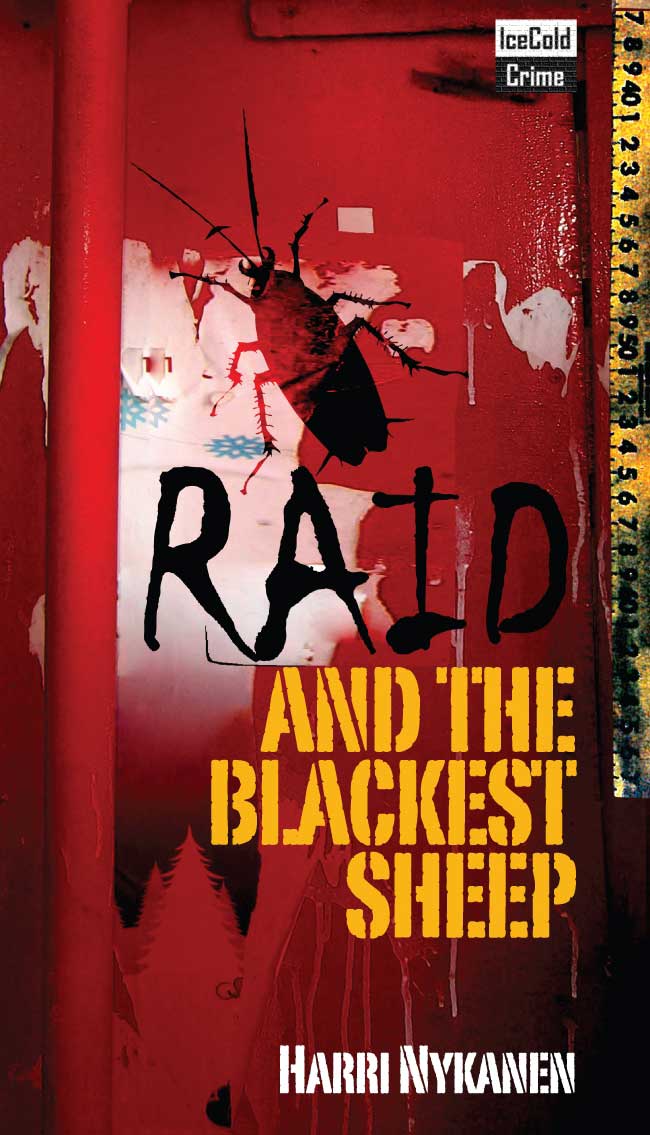
Raid and the Blackest Sheep is the first book by Finnish author Harri Nykanen to have been translated into English. In it Nygren––who has served several terms in prison for various frauds and who was a suspect in a daring robbery that netted millions and received international attention––is making a retrospective journey of his life, delivering to friend and foe alike what he feels that he owes them. He has hired a young gunman, Raid, as driver and bodyguard. And if anyone tries to interfere, well, Raid is armed and ready to handle any situation that might arise.

For such an urbane, gentlemanly, nonviolent career criminal, Nygren seems to have made an obsessive enemy in uptight Detective Lieutenant Kempas of the Helsinki police. Kempas, sure that Nygren is planning another big heist, mobilizes his force to track the pair as they wander north in Nygren's distinctive classic V-8 Mercedes. Meanwhile, the more laid-back and tolerant Detective Lieutenant Jansson, in rehab at a spa for a back injury, is receiving occasional phone calls from Raid to reassure him that while Nygren is back in the country, no new uber-heist is being planned. When Kempas calls Jansson to get information about where Raid and Nygren might be going, Jansson feels compelled to get involved. The police have learned that Nygren has terminal cancer, and Jansson doesn't want him picked up by the grim Kempas. He cuts his sick leave short and starts looking for the pair with his sergeant, Hussen.

Also tracking Nygren and Raid is the psychopathic killer Sariola, along with a couple of his enforcers. Savriola had been a participant with Nygren in the lucrative Post Office robbery a few years earlier. While he walked away with millions, he has spent it all and is planning to help himself to Nygren's share. Since Nygren has a nonviolent and fair reputation among fellow criminals, he figures it will be easy. When they catch up with Nygren at a diner and pull their guns, Raid knocks Sariola down and pours a fresh pot of coffee onto his crotch––not perhaps the wisest thing to do to a vengeful psychopath.

I enjoyed the travels and travails of Nygren and Raid, and am pleased to see that another book in the Raid series has been translated into English. The author has written over 30 books in several series, and if Raid and the Blackest Sheep is indicative, they are a bit lighter and more humorous than many of the angsty, alcohol-soaked Nordics I have read.

In Martha Miller's Retirement Plan, Lois Burnett, retired army nurse and sharpshooter, and Sophie Long, her partner of 32 years, are having a tough time financially. The money they had carefully saved for their retirement was stolen by Lois's drug-user daughter, Brenda, who had earlier left her son, Matt, with her mother to raise (great daughter, huh?). A chance remark by a friend during card night sets Sophie thinking about a novel source of retirement income. Lois, who had been taught to hunt by an uncle as a child, had purchased an M-16 assault rifle years ago, before the new regulations requiring registration of assault weapons. Sophie reasons that they have an anonymous weapon, a trained sniper, and a fair number of acquaintances with righteous grievances who wouldn't mind paying a few thousand dollars (just a few; most of their circle are on fixed incomes) for justice.

Morgan Holiday is a divorced 40ish homicide detective who moved home to care for her aging mother. As her mother's Alzheimer's progressed, Morgan was forced to put her in a nursing home. While her mother often doesn't know Morgan on her regular Sunday visits, she can still beat Morgan at chess more often than not. Morgan's partner, Henry, is nearing retirement and lets her lead on most of their cases. The last thing he wants now is this complicated case involving the series of apparent professional hits close to home. Morgan is on very good terms with her neighbors Lois and Sophie––years ago she even babysat for their grandson Matt.

Lois's first job is a convicted pedophile who has begun hanging out and chatting with neighborhood children. Nothing the police could act on, of course, until and unless a local child goes missing. Another is an abusive ex-husband who has tracked his wife through three moves, despite court orders to leave her alone. The constant harassment and terror led the woman to seek a more permanent solution. The people Lois and Raid kill are all wicked and beyond the reach of the justice system. Does that excuse their actions or those of their clients in hiring them? It's such a permanent solution. What if it was the wrong decision, if some sort of redemption was possible for their low-life targets or, heaven forbid, the wrong person is shot? On sober reflection, tempting as it might sometimes seem, I think I'd better find a different retirement hobby.

Monday, March 4, 2013

Procrastinators of the World, Unite!

Today's date brings me joyous relief. Why? It's my day to talk to you about books, and it's also National Procrastination Week. I'm not sure exactly what about procrastination we're supposed to celebrate (naturally, I'll put off investigating until tomorrow), but I choose to think we procrastinators are granted a guilt-free week for getting caught up. We can yet again resolve to do things in a more timely manner. I'll do that later. Right now I want to tell you about a book whose review fell prey to my procrastination and then I'll mention a few other good books and the movies made from them.

Liars Anonymous by Louise Ure

If you grew up in the United States, you probably heard the story of the young George Washington and the cherry tree. His father finds his beautiful tree lying on the ground and asks George if he knows who chopped it down. George replies, "I can't tell a lie, Pa; you know I can't tell a lie. I did cut it with my hatchet." Rather than punish George for cutting down the tree, his father praises him for his honesty. We'll postpone debating the truth of this legend.

On Washington's birthday in February, my idea was to write not about an honest hero, but about Louise Ure's Jessica Dancing Gammage. Washington's birthday is past, but it's never too late for reading about Jessie. If there was a 12-step program for liars, like there is for alcoholics, prosecutor Ted Dresden says she'd be its "queen and founder and president." Jessie is honest enough with us, however, to begin her narration of Liars Anonymous with these words:
I got away with murder once, but it doesn't look like that's going to happen again. Damn. This time I didn't do it. Well, not all of it, anyway.
"This time" involves Darren Markson. When the airbag in the Cadillac he's driving in the desert near Tucson, Arizona deploys, it triggers a satellite phone call to Jessie, a HandsOn car emergency service operator in Phoenix. Markson tells Jessie that he's been rear-ended and he's going to talk to the guy in the other car. She hears him get out of his car. Three people speak briefly and next come alarming noises of a physical fight before someone disconnects the HandsOn call. Jessie is disturbed enough to do something illegal. She reactivates the audio connection to Markson's Cadillac and listens to sounds that she interprets as Markson's murder.

Jessie's call to 911 prompts a Tucson police investigation of the accident site. There is some evidence left by the collision but no cars or people are found. The police ask Jessie for help interpreting the HandsOn evidence. She leaves Phoenix––where HandsOn knows her as Jessie Dancing, and Mind Your Manors housesitting service knows her, falsely, as "a former nun and nondrinker, with an allergy to pet dander"––and heads to Tucson, her hometown. There, she is known as the woman who three years earlier was acquitted of murder. She immediately runs into problems.

The story about Markson that she tells Detective Deke Treadwell is undercut by Markson's wife Emily, who knows nothing about an accident and says her husband called her the day after Jessie says he was rear-ended. Markson said he was flying to a meeting in New Mexico and that he'd left his car in the airport parking lot. Jessie, an expert in lying, diagnoses a bad liar and resents being drawn into a subterfuge.

Det. Treadwell, former partner of Jessie's retired father, and her father are the only ones who still believe Jessie isn't a murderer. Other cops and attorneys in the DA's office resent her reappearance in Tucson and are suspicious of her involvement with the missing Markson. As Jessie explains, "Declared not guilty of a crime I had committed, I was not about to be railroaded into one I had not." She has no choice but to figure out what happened to Markson.

While Jessie is sucked into the spiraling violence surrounding Markson's vanishing, she tells us, bit by bit, about herself and the murder she committed. Jessie is the first of seven children. Her mother always kept her at arm's length and now she considers Jessie dead. After majoring in philosophy in college, Jessie had been working as a bartender when her very close friend Catherine died. That's when Jessie "took over her quest" and killed someone. She confides, "You would have thought those studies would have better prepared me to come to terms with becoming a killer, but the ethics of killing were still a muddle to me. If you take a life, does it change you? Yes, in a thousand shadowed ways. Is it worth it? Sometimes."

Jessica Dancing Gammage is an extraordinary character whose story deals with personal responsibility and the gulf between guilt and innocence. Liars Anonymous is full of action, but it's Jessie, the honest liar, and the story's ending that blew me away.


My husband and I are enjoying our own crime fiction film festival. Don't put off reading these outstanding books and watching their movies:

Prizzi's Honor
Richard Condon. Two mafia killers fall in love in Condon's black comedy, Prizzi's Honor. It was made famous by the John Huston film starring Jack Nicholson, Kathleen Turner and Anjelica Huston. Condon also wrote The Manchurian Candidate, an outstanding Cold War conspiracy thriller about thought control and political assassination. It was made into a great 1962 movie with Frank Sinatra, Laurence Harvey and Janet Leigh, and filmed again in 2004 with Denzel Washington, Meryl Streep, Liev Schreiber and Jon Voight. Watch them both and see if you agree with me that the earlier one is better.

High Sierra
W. R. Burnett. In Little Caesar, crime's a hoppin' in Chicago during Prohibition. Cesare "Rico" Bandello has killed a cop and is climbing organized crime's career ladder before he's forced to run for his life. Edward G. Robinson and Douglas Fairbanks Jr. star in the classic 1930 movie of the same name. Who hasn't seen Humphrey Bogart, Ida Lupino, Alan Curtis and Arthur Kennedy in John Huston's 1941 High Sierra? Burnett wrote the noir novel about a Palm Springs, California heist before collaborating on the movie with Huston. In 1950, Huston filmed Burnett's The Asphalt Jungle, which stars Sterling Hayden, Jean Hagen and Sam Jaffe in a caper story about a jewelry robbery.

A Kiss before Dying
Ira Levin. This writer was a machine for turning out books that became movies. A Kiss before Dying involves a scheming psychopath who wants a fortune and decides that courting a rich family's daughters is one way to get it. Robert Wagner stars in the 1956 film that also introduces Joanne Woodward. Forget the 1991 remake with Matt Dillon and Sean Young. In the supernatural/horror thriller Rosemary's Baby, Rosemary and her husband Guy move into a new apartment house and when Rosemary becomes pregnant, she finds Guy and the other tenants increasingly spooky. Many of us are familiar with the movie featuring Mia Farrow and John Cassavetes. Like Rosemary in Rosemary's Baby, Joanna Eberhart feels like a fish out of water in the satirical novel The Stepford Wives. The other married women in Stepford, Connecticut are strangely docile. The Stepford Wives was filmed multiple times but the only version I like is the 1975 version with Katharine Ross. I've written before about Levin's neo-Nazi thriller The Boys from Brazil (here). I've yet to read or see Levin's Sliver, which is about voyeurism and obsession. I might take a pass on the movie unless someone can recommend it. The Rotten Tomatoes website viewers rated it a solid rotten splat, with only 12 percent liking it!

Fellow procrastinators, I hope you enjoy our week. Let's all vow to be better about being on time. Tomorrow. For now, I vote we curl up with a good book. I'm heading for the couch with Herman Koch's The Dinner. What about you?

Deciding on your style is one more good way to procrastinate

Friday, March 1, 2013

Review of Gene Kerrigan's The Rage

The Rage by Gene Kerrigan

I've been thumbing through cookbooks lately and doing a lot of baking. Maybe that's why reading Gene Kerrigan's The Rage reminded me of following an Irish recipe for a beautifully concocted explosion.

First, read the recipe's preface:

"The law was something to be manipulated for profit and power. The streets were dark with something more than night. RAYMOND CHANDLER, Trouble Is My Business"

Second, preheat the oven:

Dubliners have good reason for feeling exploited and angry. The Irish Catholic Church is rife with scandals. Favoritism among the wealthy and powerful makes a mockery of the criminal justice system. Violence has increased; the homicide-by-gun rate in Ireland is five times the rate in England and Wales. The housing bubble has popped, and the financial system is broken. Unemployment is high, and trade unions are out of fashion. As one character says, "Today, it's like everyone's grateful to be a unit of labour, to be plugged in or pulled out according to their master's will." There is so much resentment against bankers and the ranks of the privileged that Dublin's top cop is afraid to be seen in a chauffeur-driven car.

Gather the main ingredients/characters:

Detective Sergeant Bob Tidey, whose former partner Colin O'Keefe is now the Assistant Commissioner, is the veteran of several high-profile Garda cases. He is the father of two young adult children. Tidey has been divorced from Grace for four years, but he still spends the night with her when she allows it. Their relationship "is what it is." Tidey has a few drinking buddies and friends, all of whom have their own troubles: James Snead, whose son Oliver was murdered 18 months ago; Trixie Dixon, an old burglar, whose son Christy is in a jam; and Maura Coady, an elderly nun, haunted by memories. Tidey is a compassionate and loyal man, who's also morally flexible enough to commit perjury, if he thinks doing so will create a fairer solution than if he tells the truth on the witness stand.

Vincent Naylor, recently released from a prison sentence for assault, is a thug who's done jobs, including a murder, for Mickey Kavanagh, part of Frank Tucker's organized crime operation. Vincent is a walking time bomb, but he keeps himself from detonating with the warning mantra, "no emotional shit, just business." By this he means, don't rape the pretty clerk at the shop he's robbing, only focus on taking the money. Don't risk prison for something measly like shoplifting a rain jacket. Only risk prison for something worthwhile, like the big heist he's planning with a couple of friends and his brother, Noel. Like Tidey, Vincent has very strong ideas about loyalty. Although Noel is six years older than Vincent, he's a follower rather than a leader. Noel isn't the sharpest tool in the shed, but no one is better behind the wheel of a car.

Sift ingredients separately:

Tidey and Vincent feature in alternating story lines.

Sprinkle with a generous handful of woman trouble; spice with a relentless journalist, mixed hoodlums, and other rogues.

Set aside for fermenting:

While Vincent deals with problems created by his brother, the need for walking-around money, and the execution of a complex Big Crime, Tidey and Detective Garda Rose Cheney investigate the shooting death of Emmet Sweetman, a 42-year-old banker and property speculator. There is no shortage of motives or suspects; Sweetman had multiple affairs, and there were rumors he was preparing to negotiate with prosecutors looking into his shady financial dealings. There's plenty of pressure of various sorts on Garda brass and on Tidey and Cheney.

Blend carefully:

Evidence at the scene of Sweetman's death matches evidence involving another homicide. Ms. Coady becomes nervous about a car she saw two men park on her street. It's still there, several days later. These deceptively tame events bring the two story threads together.

Stick in the oven to bake. Brace yourself:

Kaboom!

In an ideal world, all of the lines between right and wrong are clear, and all choices are made on the basis of legal scripture. Needless to say, The Rage isn't set in an ideal world. Detective Sergeant Bob Tidey is a flawed hero in the mold of Chandler's Philip Marlowe, and contemporary Dublin's streets are as mean as those of Chandler's Los Angeles. While Kerrigan's writing isn't as lyrical as that of Chandler, this is a wonderfully terse and tense noirish thriller that hurtles to its inevitable, but satisfying, conclusion. It won the Crime Writers Association's Gold Dagger Award for Best Crime Novel of 2012. If you like hardboiled books that make you think, Kerrigan, an award-winning Dublin journalist, serves up an excellent read.

Enjoy.

Note: The Rage is Kerrigan's fourth standalone novel and was published by Europa Editions.