Friday, May 16, 2014

Between the covers: books about books and bookstores

The Bookshop has a thousand books,
All colors, hues, and tinges,
And every cover is a door
That turns on magic hinges.
–––Nancy Byrd Turner


As brick-and-mortar bookstores disappear all across the country, there is a sort of nostalgic yearning for them. I know that I'm always consumed with jealousy when Georgette talks about her latest visit to Powell's City of Books in Portland, Oregon.

Just recently, several books about bookstores were published (or are about to be published). These might make good choices for bookstore lovers or an upcoming book club discussion.

In Gabrielle Zevin's The Storied Life of A. J. Fikry (Algonquin Books, April 1, 2014), A. J. Fikry's Island Books is teetering on the edge of complete failure. So is Fikry, whose wife was killed in a car accident and who is now an embittered man. Not that he was necessarily all stardust and unicorns before; the man had and has very strong feelings about books and refuses to stock on the basis of what will sell.

Island Books' bookshelves reflect Fikry's tastes, and any publishers' reps and customers who think that should change get short shrift from Fikry. Fikry's low point looks like it has arrived when he, nursing a wicked hangover, discovers an extremely valuable book has been stolen from the store––and that a toddler named Maya has been abandoned there.

This is a book written for book-drunk readers, with loads of insider's comments about literature and each chapter headed by a brief review of a book or story, ostensibly written by Fikry. Mystery fans will be especially delighted to see that Fikry's first review is of that classic Roald Dahl murder mystery story, "Lamb to the Slaughter."

In Laurence Cossé's A Novel Bookstore (Europa Editions, 2010; translated from the French by Alison Anderson), Paris is home to The Good Novel, an unusual shop and, like Island Books, one with opinionated ownership. Ivan Georg and Francesca Aldo-Valbelli stock only books that have been deemed masterpieces of fiction by a secret committee of eight authors.

Who hasn't dreamed of creating the ideal bookstore? The notion of stocking only the best novels seems as good as any, and the shop is a roaring success at the outset. But there is a surprising backlash, with accusations that the shop's concept is elitist and totalitarian, and the negative reactions escalate to demonstrations and lawsuits.

Worse yet, there are attempts to murder three members of the secret committee. Who is going after the committee members? Disgruntled authors or publishers whose books are not stocked? Rival bookshop owners? Anti-elitists?

A little bit mystery, a little bit love story, and a lot of what Publishers Weekly calls "sly commentary about gatekeeping in the literary world," this is, above all, a bouquet to bibliophiles.

In Tom Rachman's The Rise & Fall of Great Powers (The Dial Press, June 10, 2014), Tooly Zylberberg is a rootless young woman who, at age 32, roots herself in a Welsh village. Not so much the village, actually, as at World's End, the barely-scraping-by used bookshop she buys and whose attic she converts into living quarters for herself and her minimal belongings. She is content to pass her days sitting on the floor reading books, chatting with her ineffectual shop assistant, Fogg, and taking long solitary walks.

That's our introduction to Tooly in 2011. We are quickly transported back to 1999, with Tooly living hand-to-mouth in New York City, with a project of walking every street in the city and, along the way, conning her way into people's apartments, just to see how they live. Then we go back further to 1988 to see 10-year-old Tooly moving from Australia to Bangkok. We bounce among these different time periods throughout the book.

In each slice of Tooly's life, she is generally on the periphery, which is maybe not surprising considering how variable her life is. She's cared for (though that makes it sound more stable and organized than it really is) by various people, including the flighty Sarah, the charming conman Venn, the uptight Paul and the bibliophile and self-proclaimed slob, Humphrey. In 2011, when Tooly gets a call about Humphrey from her old 1999 boyfriend, Duncan, she decides to return to New York and get answers about all these characters and what her proper place is in their universes––and theirs in hers.

The story is not primarily focused on books and bookstores, though they are woven throughout. Instead, this is a character-rich Dickensian story of Tooly's quest and her reassessment of what the people in her life mean and have meant to her. Rachman includes a note about bookstores he loves and yes, Georgette, Powell's is among them.
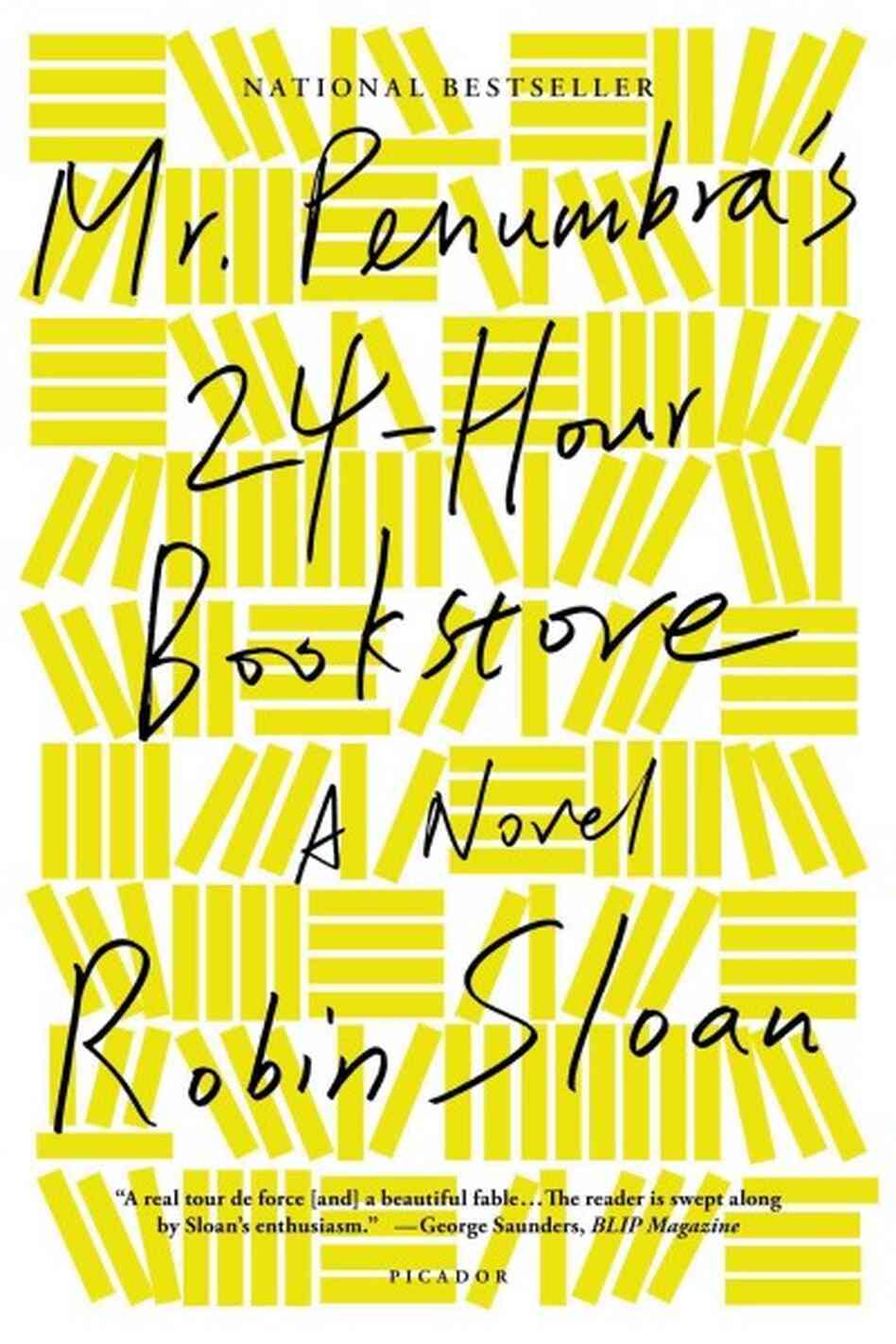
Robin Sloan's Mr. Penumbra's 24-Hour Bookstore (Farrar, Straus and Giroux, 2012) somehow manages to reconcile a love for "dead tree books" and bookstores with excitement about modern technology, especially everything Google-related. It's a fast-paced mystery/thriller about a secret society's attempts to translate an old encoded book and our techno-maven protagonist Clay Jannon's bringing his cutting-edge skillz (as the kids say) to the task.

Almost exactly a year ago, Charlie Lovett's The Bookman's Tale: A Novel of Obsession (Viking Adult, 2013) kept me up into the wee small hours––and those who know me are well aware of just how rare that is. Recently widowed young antiquarian bookseller, Peter Byerly, is driven by his grief to leave his home in North Carolina for the cottage he and his wife had just finished sprucing up in Oxfordshire, England. There, Peter slowly returns to his bookseller/hunter life.
Two accidental finds electrify Peter and lead him on quests that make for a thrilling adventure story for readers fascinated by old books and their travels through time and the lives of their owners. My full review of The Bookman's Tale is here.

There are dozens of other wonderful books about bookstores and the love of books, like Helene Hanff's 84 Charing Cross Road, Carlos Ruiz Záfon's The Shadow of the Wind and Diane Setterfield's The Thirteenth Tale, but these newer titles can be added to their shelves––after they've been read, of course.

Note: Thanks to The Dial Press and Amazon's Vine Program for providing an advance reviewing copy of Rachman's The Rise & Fall of Great Powers. Portions of this post may appear in book reviews on Amazon, goodreads and other sites under my user names there.

Sunday, May 11, 2014

They Should Have Listened to My Mother

Today is Mother's Day, and all week, I've been thinking about my mom. She was warm and smart and an incredibly good sport. She had a jones for cleanliness that was somehow never exhausted. ("A little soap and water never killed anybody." "I can't believe you can sleep in this filth!" "I didn't ask who put it there, I said, 'Pick it up!'") Despite daily setbacks, she never gave up on advising her five kids how to stay out of trouble or how to treat people. ("How many times do I have to tell you?") When we misbehaved, it wasn't because we didn't know better. I wonder if some crime fiction characters would have benefitted from her guidance.

Unlike some lawbreakers, professional robber and occasional killer Crissa Stone is capable of cutting her losses and walking away if there's serious trouble. ("I don't care who started it, I said STOP!") She's careful about the jobs she takes, and she doesn't kill when she doesn't have to. Mom would be appalled by Crissa's occupation ("Who taught you THAT? You didn't learn that in this house!"), but she would applaud Crissa's attention to detail, resourcefulness, and toughness, as well as her love for her young daughter and loyalty to Wayne, her lover and mentor (we won't tell Mom he's in a Texas prison). Her goal is admirable: a big enough score to get herself out of the crime business, reunited with her daughter, and Wayne out on parole.

Frank and Marquis, this is not my mom!
In Wallace Stroby's third series book, Shoot the Woman First (Minotaur, 2013), Crissa hooks up with a couple of guys she's worked with before, Charlie Glass and Larry Black, and Charlie's cousin Cordell, to snatch a duffle bag of drug money from Cordell's boss, Marquis Johnson, a criminal kingpin in Detroit. ("Where are you going, and who are you going with? Do I know them?") Events take a very bad turn. Crissa heads to Florida, to turn over Black's share of the loot to his family. This is not the straightforward handover Crissa might have hoped for ("Life isn't fair"), but I wouldn't have expected anything easy, given my experience with writer Stroby.

Stroby reminds me a bit of Elmore Leonard. His lyrical writing, characterization, and spot-on dialogue can put a spit polish on any old plot vehicle, but his plot never drives like it's old. This one careens like a bat out of hell, thanks to Frank Burke, an ex-cop with nothing left to lose, who talks Johnson into hiring him to recover his money. ("You can't find it? Well, if you'd put things where they belonged, you wouldn't have this problem.") Watching Frank methodically tracking down Crissa, whose sense of responsibility makes her linger in Florida, reminded me of that relentless semi driver after Dennis Weaver in Steven Spielberg's 1971 movie, Duel. A heckuvan original heroine, a villain out of your nightmares, and a pedal-to-the-metal look at good vs. evil and the role of fate in our lives. Whoa, Mama.

Let's let Mom have a crack at Paul Thomas's Death on Demand (Bitter Lemon, 2013). Four men get together six years ago for their annual boys' weekend. Two of them have soured marriages. A third, Christopher, complains that he can't just look in the phone book for a hit man to deal with his wife. ("If you can't say something nice, don't say anything at all.") Three months later, Joyce dies in a hit-and-run accident, the first of a string of fatalities in Auckland, New Zealand, that runs to the present day. ("Always wear clean underwear in case you get in an accident.") Two weeks ago, Christopher is diagnosed with a fatal illness. Now, Maori DS Tito Ihaka, exiled to the boonies from Auckland Central, is brought back to re-open the investigation that got him into trouble in the first place. ("I will always love you. No matter what.")

Ihaka is "unkempt, overweight, intemperate, unruly, unorthodox and profane." In other words, he's a maverick like Ian Rankin's John Rebus. ("So what if John's mom let him do it? If John's mom let him jump off a cliff, would you want me to let you do it too?") Ihaka is also an absolute whiz at solving cases, much to the appreciation of enigmatic Auckland District Commander Finbar McGrail and DS Johan Van Roon, Ihaka's protégé and only cop friend. It rankles DI Tony "Boy" Charlton and DS Ron "Igor" Firkitt, because they hate Ihaka. There is prejudice against Maoris and and elbowing for position in the Auckland force. Like Rebus, Ihaka has a practical attitude about maintaining productive relationships with certain criminals and dispensing informal justice to those whom the law doesn't reach. ("You must think rules are made to be broken.") Women find him very attractive.

This was my first Ihaka book, and I really enjoyed it. There are plenty of unusual characters, in addition to the complicated Ihaka, and their relationships and dialogue are very well done. The unspooling of this multilayered tale has an unpredictable rhythm, in that just when you think things are clearing up, Ihaka grabs hold of another thread, and you realize you were wrong. This book, the fourth in the series, can be read out of order, but I'll definitely be looking for the three earlier books: Dirty Laundry, Inside Dope, and Guerilla Season.

Whether you're a mother yourself or remembering your own mother today, I hope your Mother's Day is a wonderful one.

Friday, May 9, 2014

Review of Kate Racculia's Bellweather Rhapsody

Bellweather Rhapsody by Kate Racculia

It's a November weekend in 1987, and the down-at-heel Bellweather resort hotel in the Catskills is hosting its annual music convention for New York's high school talent. Twins Rabbit (Bertram really, but everybody calls him Rabbit––and that does seem like a slight improvement over Bertram, doesn't it?) and Alice Hatmaker from tiny Ruby Falls will be there, Alice for the second time.

Alice is a singer, featured in all of her high school's musical theater performances, and absolutely convinced she is destined for stardom. Rabbit is a much more low-key character. He's a bassoonist in the orchestra and hasn't managed yet to gin up the courage to tell anyone--even Alice--that he's gay.

Viola Fabian, the new organizer of the competition, is as striking and sociopathic as Cruella de Vil, and her flautist daughter plans to use this weekend as a chance to get away from her. Fisher Brodie, the symphony conductor, and Natalie Wilson, music teacher at the Hatmakers' school, are scarred veterans of their different past experiences with Viola.

Minnie Graves is an outsider to the conventioneers, but not to the Bellweather. Exactly 15 years earlier, when she was a girl, she witnessed an event outside Room 712 that has haunted her ever since, and that she hopes to exorcise this anniversary weekend. Harold Hastings, longtime Bellweather concierge, has been a witness to years of music competitions--and the mystery of Room 712.

You can just imagine the emotions, hormones and scheming when you gather hundreds of talented, competitive teenagers, and their adult supervisors, and shut them up in kind of spooky old hotel in the middle of nowhere for three days, as a blizzard approaches--maybe you've even experienced it yourself, or you had a too-much-pizza-fueled nightmare in which American Pie's band campers and Glee's singers and orchestra got transported to The Shining. When a new horror occurs in Room 712, all that intensity is dialed up to the peak setting.

Some actually are describing this book as Glee + The Shining, and I can see that, but there is more––and less––to it than that. It doesn't live up the horror potential it presents in its opening, but it does combine a young adult coming-of-age story with an amateur detective story, adding in some romance, magical realism, and some horror/suspense, all done in breezy, entertaining prose.

Racculia is one of those writers who can paint you a character portrait in just a few words, and make you feel you almost can see right into the character's soul. She directs this large cast of characters like the most skilled conductor, weaving their themes together, sometimes in harmony and sometimes clashing. Every character is a bit of a misfit, but her writing is filled with understanding and sympathy for them. (Well, maybe not Viola, but everybody else.)

I don't usually like to quote at length from a book, but there is one passage that will give you a vivid idea of the Viola and Minnie characters, and Kate Racculia's writing style.
The boy gets off at five and a woman gets on. No––a coiled, terrifying creature in woman's clothing. She is tall, though she's getting the bulk of her height from horrifying-looking red pumps that make Minnie's arches ache in sympathy. Her hair is white and pulled back in a murderously tight ponytail. As soon as she's inside, she stabs the L and then the Close Door button and casts a glance at Minnie that might as well be a shiv jerked between her ribs.

'Gotta move faster than that, honey,' this insane woman says.

It takes Minnie a moment to understand the woman thought Minnie meant to get off at five with the boy. Logical; not many people go joyriding in the elevator. Still, Minnie resents it. She knows she looks like an unremarkable cupcake. Fluffy, pale, round as a moon pie. But what Minnie resents most is this horrible woman's assumption (some would say reasonable) that if you are fat––and Minnie is fat, not overweight, not chubby, she is solid with fat––you are someone who Cannot Help Herself. Someone Who Will Defer. Someone Who Is Weak.

When the fat, in fact, is one of the few parts of Minnie that make her strong.

'Lady,' she says, and pushes the emergency stop button. The elevator jiggles to a halt. 'Do you have a problem with me?'

'Who wouldn't,' the woman says, her eyes glimmering. 'Now be a good girl and release the elevator, so I can get back to my life and you can get back to your collection of limited-edition Beanie Babies.'

Minnie stares at the woman but doesn't speak. She steps close and pushes her belly into her like a sumo wrestler. Minnie moves with surprising speed and the woman, caught off guard, wobbles on those ridiculous heels. She tries to steady herself by placing a hand on Minnie's arm.

Minnie removes the woman's hand from her arm and twists her wrist backward with a sound like a fistful of uncooked spaghetti snapping in half. The woman makes a cartoon noise––Auck!––and slams against the mirrored wall to her right. She slides down to the floor, holding her wounded wrist to her stomach, and Minnie smiles.

None of this happens in real life, of course. But Minnie imagines it so vividly she finds it hard to believe actually doing it would be any more satisfying.
This is not that dissimilar to the retribution I mete out in my head to people who cut in line, tailgate, double dip, talk on cellphones in movies, and commit other social felonies, so I thought it was delightful. There's more where that came from, so if that bit appeals to you, give the book a try. Once I was finished, I foisted it on my husband, and he enjoyed it too.

Note: Thanks to the publisher, Houghton Mifflin Harcourt, and Amazon's Vine program, for providing an advance reviewing copy. Bellweather Rhapsody was published on May 13, 2014. Versions of this review appear on Amazon, goodreads, and BookLikes and may appear on other sites under my usernames there.

Tuesday, May 6, 2014

If It's Not One Thing It's Your Mother

One of the rites of spring that I always enjoy is the opening day for Little League baseball and softball.  My town begins the season with a parade down the main street, and while there are many more marching in the parade than there are watching, it it is fun to see such happy faces on the kids and their parents. Just the names of the teams––like River Bandits and Sand Gnats––are enough to lift the spirits. Hats off to all the Little League dads and moms who are great volunteers.

Mothers and their influences have been a topic in my reading lately as well.

Will Schwalbe was working in the publishing world when his mother received the grim diagnosis of pancreatic cancer. Mary Anne Schwalbe had always lead a very active life, which at this point in time revolved around the treatment of refugees in war torn countries. It was not unusual for her to arrive home in poor health, after having contacted some kind of infection from living in poor sanitary conditions.

This time, when she arrived home from Afghanistan in early 2007, she was obviously ill. Despite seeing doctors, it took several months to pinpoint the cause of her symptoms, as is often the case with this particular malignancy. When she was given her final diagnosis, her condition was too far advanced for surgery, and her hope was for successful chemotherapy to prolong her life––but not save it.

Mary Anne's family rallied around to keep her company during the chemo infusion sessions that could last for hours. Will and his mother had always enjoyed reading and talking about books, and these discussions now morphed into a book club meant for two. There was no particular pattern in their reading choices; one or the other would mention a book they were reading or wanted to read and they both read it and shared their thoughts about it.

The End of Your Life Book Club (Knopf, 2012), written by Will Schwalbe, is the chronicle of the last months of his mother's life and how reading eased her way through a difficult time.

Over the course of the next year, this pair read books of varied genres, from mysteries like Brat Farrar to books with a psychological bent, such as John Kabat-Zinn's Full Catastrophe Living. Most of the books seemed to fall into the category that exemplifies the triumph of the human spirit over adversity, whether it was by cancer, imprisonment, war or other deprivations. No subject was too forbidding, too depressing or too violent for Mary Anne.

Mary Anne did not like silly books, however. One of Mary Anne's peculiarities was that she always read the end of the book first and then started at the beginning. In this way, she could get through the difficult and horrifying parts of books because she already knew how everything turned out.

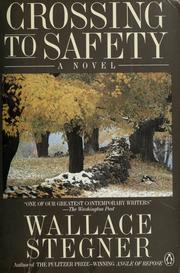
One of their favorites was Crossing to Safety, by Wallace Stegner, about the lifelong friendship of two couples, which was being changed because one of the women was dying of cancer. Another was The Savage Detectives, an ambitious novel by Roberto Bolaño, a Chilean poet and novelist, who died from liver disease before his book was translated to English. A book I would also like to read was Gilead by Marilynne Robinson, which is a narration by John Ames, an elderly preacher who has lived almost all of his life in Gilead, Iowa. He is writing a letter to his seven-year-old son, summing up the blessings of his life. Robinson writes the story as a meditation on fathers and children, particularly sons, on faith, and on the imperfections of man.

The Painted Veil, by W. Somerset Maugham, is another I added to my TBR. It is about the realization that finally comes to a self-absorbed young woman, that there are better goals in life for a woman than focusing on personal appearance and catching a mate.

Most of the books the pair read are covered cursorily in The End of Your Life Book Club, because the story is actually about the journey a son takes to become close to the mother who seemed at times to neglect her own children in her attempt to improve the lives of those children in other worlds of misery.

Mothers are a big influence in a person's life not only in the real world, but in fiction.

For Ellie Rush, the main protagonist in Naomi Hirahara's first of a new series, Murder on Bamboo Lane (Berkley, April 1, 2014), the problem is that she has been a big disappointment to her mother. Despite her mother's grand expectations, Ellie has joined the LAPD.

Ellie is half-white and half-Japanese, and she accepts the fact that she is never seen as white by whites or Japanese by the Japanese. Currently, just off probation, she has a very unglamorous job as a bicycle cop taking complaints, writing up tickets, and hearing more complaints.

While patrolling the porta-potty area during the Chinese New Year parade, Ellie is one of the first officers to come across a dead body in an alley. She is dismayed to find that the experience much worse that she thought it could be, and it was made more shocking by the fact that she recognized the body as a girl she knew in college.

Ellie has the ambition to be a detective in the homicide division, and she doesn't mind taking on menial duties that will help her career. She eagerly helps the homicide detectives, who appreciate her inside information of the suspects in the case.

This case is one that will really test her loyalties, because her friends now see her as one of "them." She has an aunt who holds a very high position in the LAPD and who expects her help, but her co-workers resent her assignment to the murder investigation.

This is an enjoyable story about a young woman at the beginning of her career who is torn over how to be a good friend as well as a good officer. She is also trying to be a good family member, but she still feels compelled to bring her pothead brother to task. Of course, in the end, Ellie's mom is beginning to take pride in her daughter's choices.

Naomi Hirahara is better known for her Mas Arai series. Arai is a Los Angeles gardener in his seventies who, as a boy, survived the atom bomb attack on Hiroshima. Blood Hina is the fourth of this series, in which Arai is aging and financially struggling, but the main problem in his life is that he is supposed to be best man at the wedding of an old friend, Haruo, and Haruo's fiancée, Spoon. Arai takes his responsibilities quite seriously. He has known Haruo for a long time and he bonded with him because they both survived Hiroshima, which left Haruo disfigured. Aside from fumbling and losing the wedding ring in a koi pond, Mas foresees trouble in this new marriage, especially between Haruo and Spoon's daughter. His foreboding is on the money because the wedding is called off when some Hina dolls are stolen from Spoon's home and Haruo is blamed.

What drew me to this mystery is that it revolves around some old and interesting Japanese customs. Rather than celebrating mothers and fathers in a festival, they honor children.

Girl's Day is a special day in Japan, celebrated on March 3, the third day of the third month. It is called Hinamaturi and it is also known as Doll's Day because the tradition of displaying Hina dolls on a tiered stand, covered by a red carpet, at the top of which are the Emperor and Empress.

It is some of these sometimes quite valuable dolls that are missing in Blood Hina, and Mas Arai knows he has to find them if his friend Haruo is to be happy. Arai must juggle his amateur sleuthing with the demands of multiple gardening clients while trying to solve a few murders at the same time.

May 5 is Boy's Day in Japan, and it always falls on the fifth day of the fifth month. Also known as the Feast of Banners, it is celebrated by banners symbolizing the family. One of the themes for the day is that of respect for the individual personalities of children.

In 1948, the government decreed this day to be a national holiday called Children's Day. It celebrates the happiness of all children and expresses gratitude to mothers.

Friday, May 2, 2014

Edgar and Agatha Are Giving Out Prizes

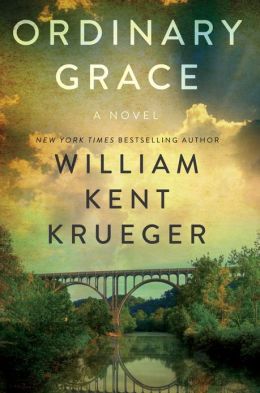
Earlier this week, Della called William Kent Krueger's Ordinary Grace a book that just felt like an Edgar Best Novel winner, and she was right. Krueger got the prize last night at the festivities in Manhattan. Now he can add that to the Dilys Award the book already won this season. The Dilys is given by the Independent Mystery Booksellers Association.

By the way, based on Della's post, I picked up another nominee, Matt Haig's The Humans for my husband. He gives it two big thumbs-up and recommends it to sci-fi readers. (Though why it was nominated for a mystery book prize is itself a mystery, he says.)

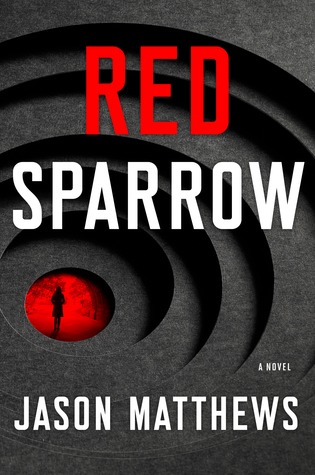
The Edgar winner for Best First Novel by an American was, ta-da, Jason Matthews for Red Sparrow. Georgette and I win that bet, but I have to admit I chose it because it was the only one of the nominees I'd read––and I liked its recipes. Odd, to have recipes in a serious espionage novel, but what do I care as long as the food is good? Try the soubise this fall, I recommend it. For a full review of Red Sparrow, click here.

The panel also presented the Mary Higgins Clark award to Jenny Milchman's Cover of Snow, a page-turner of a suspense novel set in a frigid Adirondacks winter. When Nora Hamilton's policeman husband is found dead, an apparent suicide, she is suspicious. Her quest for answers forces her to question everyone and everything she thought she knew about her life. You'll find a review of the book here.

Congratulations to William Kent Krueger, Jason Matthews, Jenny Milchman and the rest of the Edgar winners and nominees!


The Edgars aren't the only big mystery book prizes given out this week. Malice Domestic honors traditional mysteries annually with its Agatha Award. On Saturday night in bustling Bethesda, Maryland, it will award its prizes. The full list of nominees can be found here, but its big three award category nominees are:

Best Contemporary Novel

Julia Spencer-Fleming: Through the Evil Days (Minotaur)
G. M. Malliet: Pagan Spring (Minotaur)
Louise Penny: How the Light Gets In (Minotaur)
Barbara Ross: Clammed Up (Kensington Books)
Hank Phillippi Ryan: The Wrong Girl (Forge Books)

(That's a scary herd of Minotaurs in one room. Look out for the china!)

Best Historical Novel

Rhys Bowen: Heirs and Graces (Berkley)
Kaye George: Death in the Time of Ice (Untreed Reads Publishing)
J. J. Murphy: A Friendly Game of Murder (Signet)
Victoria Thompson: Murder in Chelsea (Berkley)
Charles Todd: A Question of Honor (William Morrow)

Best First Novel

Leslie Budewitz: Death Al Dente (Berkley)
Shelly Costa: You Cannoli Die Once (Pocket Books)
Kendel Lynn: Board Stiff (Henery Press)
Liz Mugavero: Kneading to Die (Kensington)\
LynDee Walker: Front Page Fatality (Henery Press)

I'm placing my Agatha bets on Louise Penny and Rhys Bowen in the two main categories. I have an aversion to cute titles, and ones with puns in them practically make me break out in hives. On that basis, then, the process of elimination leaves me choosing Front Page Fatality to put my money on in the Best First Novel category.

Any more bets on the Agathas? Will you be reading Ordinary Grace, Red Sparrow and Cover of Snow now that they've won Edgars?

Thursday, May 1, 2014

The Envelope, Please Part II: Forecasting the 2014 Edgar for Best First Novel by an American

I On Monday, I showed you the nominees for the 2014 Best Novel Edgar. It's now time for discussing the Edgar nominees for Best First Novel by an American. I'll tell you right off the bat that this will be a tough one to predict.

Before I get to that, though, I want to express a wish for opening this category to non-Americans. Americans can vie for the Crime Writers Association's John Creasey Dagger for best new crime writer of the year, and two of the nominees we'll talk about today, Roger Hobbs and Becky Masterman, were longlisted for that Dagger. At the very least, the Mystery Writers of America should add another Edgar category: Best First Novel by a Non-American. This would be a friendly thing to do especially after the Man Booker Prize people were magnanimous (some would say misguided) enough to open their prestigious competition to American authors in 2014. Let's not be stuffier than the Brits!

I'm climbing off my soap box now and getting down to the business at hand.

The nominees for the 2014 Edgar for Best First Novel by an American are:

The Resurrectionist by Matthew Guinn (W.W. Norton)
Ghostman by Roger Hobbs (Alfred A. Knopf)
Rage Against the Dying by Becky Masterman (Minotaur Books)
Red Sparrow by Jason Matthews (Simon & Schuster/Scribner)
Reconstructing Amelia by Kimberly McCreight (HarperCollins)

Here are the Read Me Deadly equivalents of the little Oscar film clips:

Matthew Guinn's The Resurrectionist involves two men whose lives are linked by the same South Carolina medical school. Nemo Johnston, a pre-Civil War slave, is purchased by the school and ordered to procure cadavers for its anatomy classes. In the 1990s, white medical resident Jacob Thacker, MD, is obligated to handle public relations for the school's dean, when the bones of dissected slaves are unearthed in the basement of the school.
 
A big Atlantic City casino heist goes haywire in Ghostman, by Roger Hobbs. The feds are circling. One robber is dead, while another is wounded by who knows who and has disappeared with the $1.2 million. The heist's organizer calls in a debt from "Jack," a criminal's criminal, and tells him he has 48 hours to fix things before the money's dye pack explodes and GPS starts beeping.

In Becky Masterman's Rage Against the Dying, 59-year-old Brigid Quinn, an FBI special agent who worked serial killer cases undercover, has been forced to retire. She has married an ex-priest and is living in Tucson, Arizona. Then the Route 66 killer, involved in the disappearance of her protégée, is captured. But there's some doubt he's the right man.

Beautiful Dominika Egorova is coerced into becoming a professional seductress (a "sparrow") for Putin's Russian intelligence service. Her assignment is to compromise ambitious rookie CIA spook Nathaniel Nash, in order to identify a Russian mole for the FSB. Sparks fly between the two and they engage in deceitful games of "spy vs. spy" in Jason Matthews' Red Sparrow.

Reconstructing Amelia, by Kimberly McCreight, involves the efforts of Kate Baron, litigation attorney and single mom, to reconstruct the last days of her high-achieving 15-year-old daughter, Amelia. Amelia fell to her death from the roof of her private school after being accused of cheating. Suicide? Or something else?

Prediction: Ai-yi-yi. I cannot believe I volunteered for this job of forecaster. Over the past few days, I've been thinking about these books and reading about their writers. I can see how they wrote these particular books but, unfortunately, it doesn't make it easier to pick the winner. I've been changing my mind hourly.

Becky Masterman
It's been a year since I read Becky Masterman's Rage Against the Dying but I remember the dread I felt reading the beginning like it was yesterday. Serial killer Gerald Peasil coolly sizes up his next victim, a white-haired "hot granny" rock hunting in the dry river bed. But this isn't the typical book that starts with a crime that the rest of the book solves by the ending. Tough as old leather Brigid Quinn, now married to a man who knows nothing of her former FBI career, isn't the typical protagonist. And the investigation that drags her back into the Route 66 case isn't typical, either.

I'm not a fan in general of serial killer books but I really liked Masterman's twists on the standard plot and her unusual characters. She's a former editor of forensic medical texts and she manages to be authentically creepy without going over the top. Rage Against the Dying has been nominated for four other crime fiction awards this year and she's seriously in the race for this one.

Roger Hobbs
Roger Hobbs takes another fairly predictable plot (the heist gone wrong) and standard characters (criminals who have fallen out) and turns it into an adrenalin-charged tour de force in Ghostman. It's not that the book is a stripped-down juggernaut, though. The narrator, a professional criminal we know as "Jack Delon" who specializes in making things disappear, goes into pages-long digressions about his craft. There were times I felt the coziness of a mentor relationship with Jack, reading all of these explanations. It's easy to see that Hobbs, a former rifle range instructor and recent college grad, must be a natural-born scholar.
  
Hobbs writes with such assurance and Jack's narrative voice is so unusual that this book is a rare first. It was awarded the 2013 Steel Dagger Award for best thriller by the Crime Writers Association and was named a finalist for two other awards in addition to this Edgar nomination. It's in the running for sure.

Kimberly McCreight
Kimberly McCreight's lawyer-single mother Kate Baron had my sympathy in Reconstructing Amelia, although I felt I knew her less well than her teenage daughter Amelia, a bright student who is close to her mother. Amelia is brought to life through her first-person media posts and texts, which appear in alternating chapters and provide the gist for Kate's research. Kate is allowed to sit in on a detective's interviews and I had a hard time swallowing this, especially surprising coming from lawyer/writer McCreight. Better was the Brooklyn setting and the depiction of the special hell high school creates for some students. This is a popular book that wasn't quite to my taste. I could be wrong but I don't see it winning.

Matthew Guinn
Matthew Guinn's slave, Nemo Johnston, is a memorable character. He takes easily to his night job of supplying cadavers for a Columbia, South Carolina medical school. He robs African-American cemeteries of their dead and even creates his own corpses on occasion. By day, he's a skilled surgeon/teacher in the school's anatomy lab (you can imagine some of the gruesome scenes) although he isn't compensated accordingly. His story is more interesting than that of the Xanax-addicted young doctor who faces a moral dilemma when he's asked to cover up the 1990s discovery of the African-American bones in the medical school's basement.

Guinn's novel is uneven but still a good southern gothic. I'll look forward to his next but I think this isn't his year.

Jason Matthews
Some of the best British espionage writers actually worked in intelligence and now there's an American espionage writer, Jason Matthews, who was a spy for 30 years. It's a joy to read his book, Red Sparrow, filled with an insider's knowledge of spycraft.

His Russian "sparrow," Dominika Egorova, is lovely and I rooted for her even though I'm an American. I also liked the target of her training and charms, newly minted CIA agent Nathaniel Nash. Their dialogue was perfectly done. I agree with Sister Mary's criticisms (see her review here) but the shortcomings of this book are minor. A terrific book nominated for two other awards and this Edgar. Of these five books, I liked it the most. Well, maybe. I can't decide.

And now we're down to it. It's between Matthews, Masterman and Hobbs. It wouldn't surprise me if any of them won but I'm going with Masterman. I think the Mystery Writers of America will be pleased to honor a female writer who created an unusual female protagonist and breathed new life into a novel about serial killers, Rage Against the Dying.

Pickin' the winner out of the hat: Becky Masterman's Rage Against the Dying

Rollin' the dice, winner high: Matthew Guinn's The Resurrectionist

Okay, I gave it a shot. Three shots, actually. Maybe the pick of Masterman twice is prophetic. Now please tell me who you think is going to win this Edgar.