Wednesday, April 29, 2015

I'll Take Genre Benders for Wednesday, Alex

Today, we're going to talk about benders. We'll skip our wild drinking sprees and car accidents and look at a couple of recent books that bend the boundaries of historical fiction. Later this week, I'll show you some other genre straddlers.

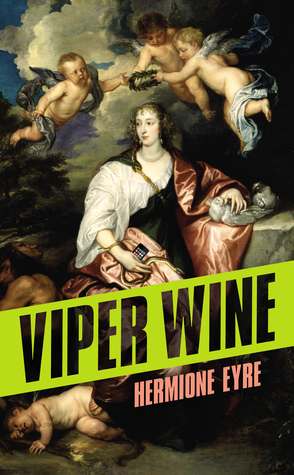
Let's start with Hermione Eyre's first novel, Viper Wine (Hogarth/Random House, April 14, 2015). The UK cover on the right features van Dyck's portrait of Venetia, Lady Digby, a real woman so famed for her beauty during the reign of Charles I, she inspired Ben Jonson's poetry and caused common folks to run alongside her carriage in the hopes of glimpsing her. If you look closely at the book's cover, you can see that a cellphone has been slipped into Venetia's hand. Some other modern products (I am not kidding when I tell you Spam––the pink, edible variety, not the annoying email––is one of them), famous people (i.e., Groucho Marx and Naomi Campbell), and discoveries show up in Eyre's book. Occasionally, these appearances are somewhat jarring or confusing, but I found most of them amusing. Elements of fantasy, magical realism, and time travel feature in this witty book of historical fiction. The writer herself even steps into the pages.

The US cover
Eyre gives us her take on the lives of Venetia and her husband, the unconventional Sir Kenelm Digby. Kenelm was an alchemist, explorer, and intellectual who collected books and corresponded widely. He was besotted with his wife and crushed by her mysterious death at age 32. In Viper Wine, Kenelm receives messages from the future through a blipping obelisk. While the wheels in Kenelm's head are whirling madly, Venetia spends her time on a hell-bent quest to regain the youthful freshness of her beauty. Kenelm's protestations that she is still beautiful (still!) only make things worse. Maybe I should have been more understanding, but my patience wore thin. I wanted to yank Venetia out of the book and shake her til her teeth rattled. Instead, I gawked as Venetia visited charlatan physicians in Eastcheap, I learned pre-Botox beauty recipes that made me very glad my drugstore stocks Neutrogena, and I witnessed events such as an early submarine excursion under the Thames. This original novel is not for everyone, but is written for readers who appreciate well-researched historical fiction and are looking for something different. I'll be interested to see what Eyre does next.

The death of the beauteous Venetia opens Viper Wine. Benjamin Percy's The Dead Lands (Grand Central Publishing, April 14, 2015) opens this way: "She knows there is something wrong with the baby."

Thus begins a post-apocalyptic tale set 150 years after an airborne flu (H3Ll) killed millions. The flu was so deadly, other countries launched nuclear weapons against the US in futile attempts to try to stop it. The resulting radiation accounts for the wasted Dead Lands inhabited by nightmarish beasts, such as hairless wolves and gigantic spiders, outside the Sanctuary created in what used to be St. Louis, Missouri. The 40,000 Sanctuary inhabitants believe they are the world's last human survivors. They are surrounded by a high wall of plaster, mortared stone, and metal cars.

One of the wall's sentries is Wilhelmina “Mina” Clark, a hot-headed young woman who feels not sheltered, but imprisoned in the Sanctuary. There, society has taken a backward turn, and water is running out. The new mayor, Thomas Lancer, and his sheriff, the genuinely creepy Rickett Slade, have created a society based on fear. One day, something happens to inspire Clark, oddball museum curator Lewis Meriwether, and their small band to escape and head for Oregon. It isn't clear how much the expedition members can trust each other. The Sanctuary's mayor schemes to stop them, but the Dead Lands could kill them first. Meanwhile, back at the Sanctuary, Lewis's museum assistant, Ella, and her friend, Simon, a thief, put their heads together.

All this is told in a very rich prose that you will eventually get caught up in, as I did, or find too much. Here's a sample:
"This morning, as the sun rises and reddens the world so that it appears it might catch flame, Clark stands at her sentry post atop the wall. Around it reaches a burn zone of some seventy yards. Beyond this grows a forest with many broken buildings rising from it, black-windowed, leaning messes of skeletal steel and shattered stone. The remains of the St. Louis Arch, collapsed in the middle, appear like a ragged set of mandibles rising out of the earth. In the near distance, where once the Mississippi flowed, stretches a blond wash of sand."
Then, too, if you've read a lot about Lewis and Clark, as I have (in the Pacific Northwest, references to the Expedition are everywhere), you might be taken aback by Percy's eccentric portraits of the Expedition members' namesakes. Along with tamping down these intrusive thoughts, I had to ignore the voice of my scientific knowledge reminding me Percy's Dead Lands creatures are very unlikely results of radiation-caused mutations. If you don't have fixed expectations and can get past the scientific implausibilities, the journey's logical inconsistencies, and the nature of Percy's re-imagined historical characters, you might enjoy this mashup of historical and dystopian fiction, horror, fantasy, sci fi, and adventure thriller. I did, and now I'm amusing myself by mentally casting characters for a potential movie. I can't get a handle on the actors yet, but the Coen brothers would have to direct.

Wednesday, April 22, 2015

Crimes Against Nature

Activism in the 1970s brought us Earth Day, a day to celebrate and appreciate our planet. In the USA, it is today, April 22. The Free Love era also brought us sit-ins and love-ins, but even then I was more interested in the where- and why-fors of how victims got done in.

If you would like to read about murderous sit-ins, grab Catherine Aird's Parting Breath, in which a local university student would have lived longer had he avoided the protest and stayed home.

On the other hand, if you want to celebrate Mother Nature in an armchair sort of way, over the years there has been an explosion of mystery books that use the environment and other ecological concerns as backdrops for crimes that upset the balance of nature.

What makes for a good story is conflict, and there is certainly many a disagreement between the Green Peacers, the tree huggers, the loggers, the conservationists, the farmers, the hunters, the fishermen and the environment.

One of my favorite authors, Tony Hillerman, set his Navajo series in the Southwest, and he used environmental themes as a basis for intricate plots. His eighth novel, A Thief of Time, was published in 1988. In it, he makes the point that the ability to understand the past is lost when anthropological sites are destroyed. While his mysteries are always intriguing, it is his settings that leave a lasting memory. In fact, one way to really enjoy a Hillerman book is to have by your side a photographic companion volume with pictures taken by Tony's brother, Barney Hillerman. It's titled Hillerman Country.

Another series, which highlights some of the best and most beautiful ecological gems in this country, is the Nevada Barr series featuring park ranger Anna Pigeon. Anna has 18 cases to her credit, as she has solved crimes set in different United States National Parks, from Carlsbad Caverns in New Mexico to Isle Royale in Michigan.

Track of the Cat, the 1993 novel that introduces Anna, is set in the Guadeloupe Mountains of Texas. Author Nevada Barr draws from her own experiences as a park ranger, and she always leaves the reader better informed about nature in its many guises.

Many writers have followed in Barr's footsteps. Dana Stabenow writes about Alaska, Sandra Brannan writes about South Dakota, Suzanne Arruda about Africa, Sandi Ault about northern New Mexico, and Sarah Andrews about Wyoming. In these series, there is a wealth of clashes between humans and the environment to stimulate the imagination.

Wildlife conservation is the theme of Jessica Speart's 1997 novel, Gator Aide, and she showcases different endangered species in each book of her series. Her protagonist, one–time actress Rachel Porter, leaves New York to become a US Fish and Wildlife agent. Before she realizes it, she is chasing down poachers in the Louisiana Bayous or looking for endangered tortoises in the desert. These books are fun.

Many writers have tackled environmental issues from a birdwatcher's perspective. I seem to be drawn to these twitchers, as they are called. Ann Cleeves's latest books are set in areas well known for their bird populations, such as Northumberland and the Shetland Islands. But her first books recount the birding adventures of George Palmer-Jones, an amateur birder who always finds himself involved in murders. Even twitchers can resort to violence when avian habitats are endangered. Palmer-Jones birds in Surrey, England. These early books are hard to come by, but worth looking for.

Christine Goff wrote a series of birdwatcher mysteries set in the Rocky Mountains. The series begins with A Rant of Ravens, and all books focus on the environment and the concerns of the aviary population.

Clearing out some books recently, I was re-attracted to J. S. Borthwick's The Case of the Hook-Billed Kites, which is about birding and crime in Central Texas. I enjoyed the re-read and passed the book on.

When it comes to the piscatorial denizens of the lakes and rivers, look to Victoria Houston for a good fish story. Chief of Police Lewellyn Ferris and her pal, Paul ("Doc") Osborne, are ardent environmentalists in Loon Lake, Wisconsin. They love the art of fly-fishing, which seems to lead them to dead bodies.

Glyn Carr's novels explore the beauties of nature in the thin air. His protagonist, Sir Abercrombie ("Filthy") Lewker, solves tricky crimes of the locked-room variety that come to pass in the difficult terrains of mountains from the Alps to Wales.

Mary Daheim also takes the high road and pits her newspaper owner and editor, Emma Lord, against California land developers who want to change a mountain into a luxury spa in The Alpine Gamble. There is no end to the havoc that ensues when tempers flare.

Take your pick, choose a side, and take a stance on global warming.

Better yet, just go outside today. Take a deep breath and walk a ways while you are deciding what your next literary adventure will be. If it has an ecological theme, let us know about it.

Wednesday, April 15, 2015

Books Just Out or Arriving Soon May be Just What You Need

It happens to all of us on occasion. You look at your pile of unread books, and none of them are what you feel like reading. Maybe you need this list of books just released or due to be published soon. (The quotations are from the books' publishers.)

Already Available

C. J. Box: Endangered (Putnam), a Joe Pickett novel involving the Wyoming game warden's investigation of Dallas Cates and his godawful family, after Joe's 18-year-old ward, April, who ran off with Dallas, turns up gravely injured.

Erik Larson: Dead Wake (Crown), the story of the sinking of the Lusitania, published to coincide with the disaster's 100th anniversary.

Dennis Lehane: World Gone By (William Morrow), the third installment in the epic trilogy about Joe Coughlin, the son of a Boston cop who grew up to be a gangster, is set in Cuba and Ybor City, Florida, during World War II.

Steve Berry: The Patriot Threat (Minotaur Books), a thriller featuring ex-Justice Department intelligence agent Cotton Malone  and posing the question: What if the Federal income tax is illegal?

T. C. Boyle: The Harder They Come (Ecco), "a powerful, gripping novel that explores the roots of violence and anti-authoritarianism inherent in the American character."

Olen Steinhauer: All the Old Knives (Minotaur Books), in which ex-CIA case officers and former lovers Henry Pelham and Celia Harrison get together for dinner in Carmel, California, and discuss a hostage disaster in Vienna six years ago.

Graeme Cameron: Normal (Mira Books), a black-humored thriller that invites us to discover the humanity of a serial killer as he develops friendships and falls in love.

Daniel Torday: The Last Flight of Poxl West (St. Martin's Press), a novel in which "a young man recounts his idolization of his Uncle Poxl, a Jewish, former-RAF pilot, exploring memory, fame and story-telling."

Alexander McCall Smith: Emma (The Austen Project, No. 3) (Pantheon), a modern-day retelling of Jane Austen's  Emma from the author of the No. 1 Ladies' Detective Agency series.

Elizabeth Berg: The Dream Lover (Random House), "based on the scandalous life of the French novelist George Sand, her famous lovers, untraditional Parisian lifestyle, and bestselling novels in Paris during the 1830s and 40s."

Lisa Scottoline: Every Fifteen Minutes (St. Martin's Press), a "visceral thriller . . . [that] brings you into the grip of a true sociopath and shows you how, in the quest to survive such ruthlessness, every minute counts."

Liza Marklund: Borderline (translated from the Swedish by Neil Smith; Emily Bestler Books/Atria), a thriller in which "Annika Bengtzon tracks an unknown adversary through a web of lies and violence--bringing her face-to-face with a terrifying enemy."

Benjamin Percy: The Dead Lands (Grand Central Publishing), "a post-apocalyptic reimagining of the Lewis and Clark saga, [in which] a super flu and nuclear fallout have made a husk of the world we know."

Available on April 21

Greg Iles: Bone Tree (William Morrow), the second installment (first book is Natchez Burning) in Iles's trilogy about race, family and justice, featuring Natchez, Mississippi lawyer Penn Cage.

Bruce Holsinger: Invention of Fire (William Morrow), a thriller featuring medieval London poet and fixer John Gower, by the author of A Burnable Book.

Amanda Quick: Garden of Lies (Putnam), a novel of intrigue and murder in Victorian London.

Available on April 28

Matthew Pearl: The Last Bookaneer (Penguin Press), "[a] swashbuckling tale of greed and great literature [that] will remind you why Pearl is the reigning king of popular literary historical thrillers" (Library Journal's starred review).

Monday, April 13, 2015

Books for the Ides of April

I know I'm not Thomas Paine, facing the American Revolution, but I can still say these are the times that try men's souls: the overwork and overworry of tax season. As she related on Saturday, Sister Mary Murderous has been taking refuge in a flood of good TV dramas. My zonked outedness at the end of the day and subsequent middle-of-the-night awakenings have cast me into reading one book after another. I mean, I must achieve a suspension of disbelief somehow, if not in sweet dreams, then in a work of fiction––and I'm not talking about our tax returns! The books below are all timely for the Ides of April.

Maybe one of these days we'll see a greedy Owen Laukkanen villain cheat on his taxes. So far, they've been too engrossed with kidnapping (The Professionals), armed robbery (Criminal Enterprise), and running a murder-for-hire operation (Kill Fee) to bother. In The Stolen Ones (G. P. Putnam's Sons, March 2015), we watch a criminal hierarchy involved in the despicable crime of trafficking women. The man at the top is called the Dragon. His financial demands and reputation for ruthlessness put tremendous pressure on Brighton Beach's Andrei Volovoi, whose truck drivers deliver the shipping containers of victims to their final US destinations. Like all of Laukkanen's villains, Andrei considers himself a regular American businessman. Andrei likes to think that any eastern European woman dumb enough to fall for the trap presented by the American dream deserves the box and whatever comes after.

Then one of Andrei's drivers kills a curious sheriff's deputy and Irina Milosovici, who speaks only a smidgeon of English, escapes from the truck's container. Her beloved younger sister, Catalina, remains trapped with others in the box as the truck drives away. [Note to self: Never be reincarnated as a Laukkanen criminal caught in the middle between cops and worse criminals, although Andrei rises––or perhaps the better word is "sinks"––to the occasion.] What ensues is one of the writer's patented three-ring circus thrillers that also examines a serious social issue. Point of view and setting get juggled between the scrambling bad guys, the separated but feisty Milosovici sisters, and an engagingly mismatched duo of good guys: Kirk Stevens, a veteran in the Minnesota Bureau of Criminal Apprehension, and Carla Windermere, a hotshot FBI special agent. Tension in The Stolen Ones is already the high-wire sort, but Owen Laukkanen, crafty as usual, yanks and twists the wire. Put this guy on your thriller writers must-read list. I feel like I've popped a Xanax when I hear he's working on another.

After a difficult session with the calculator, take a break with the soothingly cynical company of an Italian crime solver. Michael Dibdin's Aurelio Zen, Donna Leon's Guido Brunetti, and Andrea Camilleri's Salvo Montalbano come to mind. Add to these Timothy Williams's Commissario Piero Trotti of the Polizia di Stato in northern Italy. The fourth series book is Black August (originally published in 1995 by Trafalgar Square Publishing; re-released by Soho Crime, January 2015). Trotti is a bit like Ian Rankin's Edinburgh cop, John Rebus, whose life revolves around his work, although Trotti's vice of choice is hard candy rather than the bottle. Like Rebus, Trotti is honest and efficient, but his methods are out of the Dark Ages. He alienates people and can't work on a team.

When the questore, who's read Machiavelli's The Prince, warns him to get out of town on vacation rather than join the Rosanna Belloni murder case, Trotti interprets this to mean the questore really wants him to investigate. This is convenient thinking. Rosanna, a retired headmistress whose corpse is found, battered beyond recognition in her bedroom, is an old friend whom Trotti met 20 years earlier when her student, Anna Ermagni, was kidnapped. With this book, you look at the nature of friendship, professional loyalty, and the mental health system, much more pleasant than checking your Form-1040 figures.

I'll tell you right off the bat, screenwriter Daniel Pyne's novel, Fifty Mice (Blue Rider Press, December 2014), isn't for everybody. For one thing, it's noir of the paranoid variety and deals with themes of reality, memory, identity, and fate. For another, it opens with the kaleidoscopic images and confusion of Jay Johnson's abduction off a Los Angeles Metro train, and what's going on in Jay's subsequent Kafkaesque situation only becomes clear to him and the reader over the course of the novel.

When Fifty Mice begins, Jay is 30-ish something and engaged to be married. He currently works in telephone sales, although he previously worked with data obtained from experiments run on laboratory mice, and he still hangs out at his friend Vaughn's lab. This brings us to yet another reason this book isn't for everyone. Laboratory mice have never been as sympathetic as they are in the tidbits Pyne throws our way. They are in about as much control of their tiny, tragic lives as is Jay, because the outraged Jay finds himself trapped in a Witness Protection program on Catalina Island, off the coast of California, an unwilling possessor of a new identity for God-only-knows-what reason. Jay is clueless, but the feds don't believe that for a moment. It will be to Jay's advantage to figure out, uh, something. After reading these reasons for not recommending this book to every reader, those who will enjoy this memorably original noir know who you are.

I still have some experimenting to do with my income taxes. I wish you the best with your own.

Saturday, April 11, 2015

Even More TV Crime

I wish I could tell you that at the end of the day, I sit with a glass of sherry and read some improving literature. The fact is, though, that it's more likely to be a glass of beer (but a microbrew, so maybe that counts for something) and a crime drama on TV. Sure, I read plenty of books, but aside from history, I've pretty much abandoned improving books in favor of genre fiction, especially mysteries. Now that it's tax season, though, even that seems like too much work. I'd rather just let TV drama wash over me.

You already know what a complete fangirl I am for the late Veronica Mars. When I heard that its creative team, Rob Thomas and Diane Ruggiero, were venturing back into TV, I got excited. Then I heard it was to be a zombie show called iZombie. Yuck. I can't stand all that vampire/zombie/paranormal stuff. But I had to check it out, in spite of my aversion to that particular genre––and a fervent desire not to see anybody eating brains while I'm trying to digest my dinner.

It turns out that iZombie's protagonist, Liv Moore (played by Rose McIver), is basically a more grownup––and undead––Veronica Mars. Same snarky voiceover, same petite blonde pitbull attitude, same dark cloud following her around. The whole zombie thing keeps me from being totally in love with it, but I like it and it's on my DVR series queue.

The show begins with Liv as a smart and talented medical intern in Seattle who decides to take a night off to go to a party on a boat, at the urging of one of her intern colleagues. Liv isn't enjoying the party much and is about to leave when all hell breaks loose with people screaming, running, the boat on fire, you name it. Some guy attacks Liv and the next thing you know, she's waking up in a body bag on the beach and freaking out the one witness who sees her emerge from the body bag and stumble away.

It takes Liv a little while to realize that she's a zombie––though the pallor, circles around the eyes, strawlike hair and sudden craving for brains (with sriracha sauce, please; this is the 20-teens, after all) give it away. She switches to working in the Seattle PD morgue so that she doesn't have to kill anybody to access their gray matter. Her boss there, Dr. Ravi Chakrabarti, is the one person who figures out her secret and decides to figure out if he can cure zombie-ism. (That would look pretty good on a CV, right?)

Liv finds that when she eats a corpse's brains, the person's thoughts, feelings and attitudes flood into her consciousness, including, in some cases brief flashes of their murders. She wants to help the police solve the murder cases, but she can hardly tell them how she comes across her knowledge, so she claims to be a psychic. She ends up working with another snark-meister, Detective Clive Babinaux. Their relationship is the most frequent source of the show's smartarse repartée.
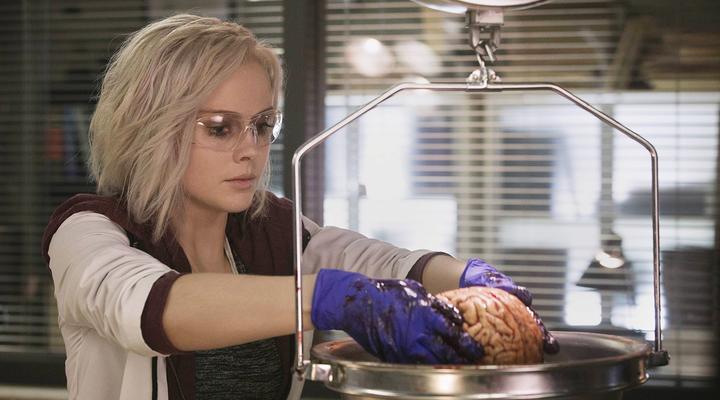
Rounding out the main cast is Liv's society matron mother, her best friend and roommate, and her former fiancé, Major Lilywhite (seriously, that's the character's name), whom she felt she had to break up with out of a fear that some evening she might be overcome by a desire to crack his head open and feast. No drama is complete without a nemesis, and Liv's is another zombie, Blaine DeBeers. Blaine has none of Liv's scruples about getting ahold of brains only from the already dead, and he's quickly turning into the creator of a Seattle zombie subculture. His clashes with Liv are another source of some very entertaining dialog.

If you enjoyed Veronica Mars or you're into the whole vampire/zombie thing, check out iZombie. It's on the CW network on Tuesdays at 9pm Eastern. Catch up on past episodes on the CW site, here.

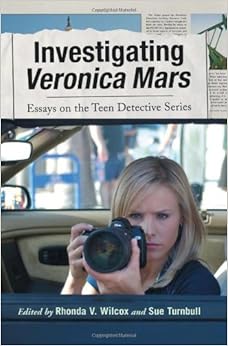
I need to digress for just a minute. Did you know there is actually a book of scholarly essays about the Veronica Mars TV show? Well, there is. It's titled Investigating Veronica Mars: Essays on the Teen Detective Series (McFarland, 2011). Here's its description:
During the course of its three seasons, Veronica Mars captured the attention of fans and academics alike. The 12 scholarly essays in this collection examine the show's most compelling elements. Topics covered include vintage television, the search for the mother, fatherhood, the show's connection to classical Greek paradigms, the anti-hero's journey, rape narrative and meaning, and television fandom. Collectively, these essays reveal how a teen television show––equal parts noir, romance, social realism and father-daughter drama––became a worthy subject for scholarly study.
I don't feel compelled to read it, but this makes me feel a little less weird about being an AARP-eligible VM fan.

Did you watch the drama Fortitude that I previewed here? Thursday night was the season finale and all I can say is that this was one very weird Nordic police procedural, what with people being turned into murder machines by prehistoric insects crawling back to life out of mammoth corpses that had become exposed because of climate change. The plot is, needless to say, a little on the crazy side, and its strands are complicated (check out this infographic), but it is still compelling to watch, because of the intensity of the acting and its outstanding cast.

The big names, Michael Gambon and Stanley Tucci, are as good as you'd expect, but the lesser-known actors really grab attention, especially Richard Dormer as Sheriff Dan Anderssen. The sheriff is superficially a bit of a brute, but with a whole lot more going on under that surface. If you want to get more information about Fortitude and see some videos, head over here. I was surprised to hear that despite the show's body count, there will be a second season. I'll be watching.

I will confess to you that from 2003-2008, one of my real guilty pleasures in TV watching was Las Vegas, a show set in the fictional Montecito resort and casino, which focused on the Montecito's security and other operational personnel. The cast included James Caan, as head of operations, and his principal security officer, Danny McCoy, played by Josh Duhamel.

Josh Duhamel is back in a new police procedural called Battle Creek. Surprise, it's set in Battle Creek, Michigan. Local police detective Russ Agnew (played by Dean Winters) is a hangdog, rumpled mess and could win awards for cynicism. Agnew is perennially disgruntled by the department's lack of funding and, as he sees it, respect. As the show begins, he feels even more put upon than usual when the FBI sets up across the hall and the impossibly handsome and charismatic Agent Milt Chamberlain (honestly, what is with these character names?), played by Duhamel, is assigned to be the new liaison between the FBI and local law enforcement. In other words, Milt is now Russ's extremely unwanted partner.

The dynamic between the partners is entertaining, and we're still not sure we've been given the real reason why Milt is in Battle Creek, rather than off in some less backwater-ish city and quickly climbing up the ranks. The other cast members are fun to watch too. The great English actress, Janet McTeer, plays Commander Guziewicz, and you'll recognize Kal Penn from the West Wing as Detective White.

The crime-of-the-week plots are decent. They had this Mainer at the second episode, which featured a death-by-maple-syrup murder. The most recent episode did fall into the old the-recognizable-guest-star-dunnit trap (see How to Watch TV Crime Dramas if you want to know my formulas). As soon as my husband and I saw Peter Jacobson, who used to play Dr. Taub on House, we knew he'd be the perp; it was just a question of how and why. Still, it was an entertaining way to spend an hour. If you'd like to give it a try, it's on CBS on Sunday nights at 10pm Eastern. Here's the most important thing: this coming Sunday, the guest star is Candice Bergen––and she's playing a con artist!

By the way, speaking of exceptions to the recognizable-guest-star-dunnit rule, when we watched Bones on Thursday night (yeah, yeah, yeah, that's a lot of TV watching), we spotted Jason Gray-Stanford, who used to play Lt. Randy Disher on Monk. Well, obviously, he was going to be the killer, right? But Bones pulled a fast one and didn't follow convention this time. I have to tell you, though, their killer wasn't believable. They should have followed the formula!  (UPDATE––WITH A SPOILER: A month later, Bones revisited the serial killer case in that episode, and Randy Disher turned out to be the killer after all. The formula wins again!)

Wednesday, April 8, 2015

Review of E. J. Copperman and Jeff Cohen's The Question of the Missing Head

The Question of the Missing Head, by E. J. Copperman and Jeff Cohen (Midnight Ink, 2014)

What is your favorite Beatles song? This is one of the first questions that Samuel Hoenig asks his clients. He finds it gives him added insight into a person's character. One thing Samuel needs is a bit of help when relating to other people. But who doesn't? It’s just that Samuel is what is known as "on the spectrum." He was diagnosed with Asperger's almost immediately after the condition was officially designated in scientific terms.

Samuel doesn't consider it a mental illness; rather, he is convinced that it is merely a personality trait that hinders him in communicating and relating to others. In his view, this is a quality that is evident when most strangers interact. Asperger's also provides him with certain tendencies, which he finds very useful. Even though some might consider him odd, Samuel is sure that he behaves most rationally.

Samuel's main forte is his ability to research and gather information––mostly over the Internet. At the suggestion of his supportive mother, he opened his own business in Piscataway, New Jersey, appropriately named Questions Answered. He has a slow, steady stream of clients, the latest of whom is a gambler who wants to make wagers related to the fact that different wind currents might change the possibility of hitting an out-of-the-park home run at Yankee Stadium.

When Janet Washburn calls Questions Answered, she only hopes for the answer to a crossword puzzle clue, but she finds herself asked to come to the office and help Samuel solve the baseball problem––in return for her answer. Janet, a laid-off news journal photographer, follows her instincts and is drawn into an unexpected adventure because, shortly after her arrival, another new client shows up at the door.

He is Marshall Ackermann (favorite Beatle tune: Eleanor Rigby; pretentious, terrified of death and sees himself as lonely), the head of the Garden State Cryonics Institute. This is a facility where people hoping for a better, gentler future have put their mortal remains in suspended animation with the help of liquid nitrogen.

Apparently, when the bodies of the customers are prepared for the freezing process, their heads are kept separately from their torsos and extremities. Ackerman is in a dither because one of his most important heads is missing. Samuel enlists Janet's help on this case as well and, before the investigation begins in earnest, they find the body of one of the doctors at the institute in one of the container rooms. Samuel realizes almost immediately that this is a case of murder.

When the police arrive, they are a bit blinded by science and Detective Lapides (Help; energetic, articulate, possibly sees himself as a victim, aware of his own limitations) appreciates Hoenig's help.

Hampered by Charlotte (You Know My Name, Look Up The Number; complete and utter lunatic), who refers to herself as a citizen journalist, and sometimes by both Washburn and Lapides, the sleuthing duo––in total ignorance of the fact that they too are in danger––sort through the suspects and the motives.

Authors Copperman and Cohen appear to be two sides of the same coin; one author writing under two different pen names, each of which has different interests.

Copperman has written several mystery series, all of which take place in New Jersey and all of which are humorous cozies. Jeff Cohen, on the other hand, has written about Asperger's syndrome. When this dimorphic personality works together, the results are like two outs on an infield fly, which is something unexpected and extraordinary, because you have to fool the umpire.

The story moves at a rapid pace and the excitement mounts slowly and nicely to a credible, complex twist at the end. The humor is much more subtle than in some of Copperman's series, where he is labeled "King of the Zingers." Samuel's unusual perspective and his interpretations are so discerning that I couldn't help but laugh frequently, mostly at myself because I hadn't appreciated the irrationality of some of the things we all say and do.

If you enjoyed the Rosie books by Graeme Simsion, you might enjoy this book. Samuel's interests are police procedures, baseball and the Beatles. His favorite song is Strawberry Fields Forever. It is one of my favorites but the top of my Beatles list is In My Life. What's yours?

Thursday, April 2, 2015

Review of Philip Kerr's The Lady from Zagreb

The Lady from Zagreb, by Philip Kerr (G. P. Putnam's Sons, April 7, 2015)

A good detective should always be honest, but not too honest

So says Bernie Gunther to a visiting Swiss detective (and crime fiction author) as Bernie produces from his pockets a bottle of pear schnapps and SS-etched glasses that he lifted from an stately home where he'd been a speaker at an international crime conference. Considering that the stately home had itself been appropriated from its owner by the SS, Bernie's pilfering seems only fair.

This latest 10th adventure of Bernie Gunther, cynical German gumshoe, takes place mostly in 1942, in Germany, Switzerland and Yugoslavia, with some flash-forwards to 1956 on the Côte d'Azur. The 1942 Bernie is back home in Berlin from his time in Smolensk as an investigator with the Wehrmacht War Crimes Bureau. (Yes, there really was such a thing––and no, of course the Nazis didn't investigate their own genocidal atrocities.)

Coming back to Berlin is a lot better than being in Smolensk, but it has its drawbacks. Bernie, no fan of public speaking, is coerced into giving that address at the international criminal conference. He's also once again summoned by Propaganda Minister Joseph Goebbels (whom Bernie calls––though rarely aloud––"Mahatma Propagandhi" or "Joey the Crip") to do a little job for him. The job is to travel to Yugoslavia to get a message to a certain Father Ladislaus from his long-lost daughter, who is now up-and-coming film starlet Dalia Dresner.

Kerr says he based the Dalia character in part
on film star––and inventor––Hedy Lamarr
Goebbels, whose serial lusts are legendary, has a yen for Dalia. Both Goebbels and Dalia are married and she has resisted his advances, even risking her future at the UFA film studios, which Goebbels controls. Goebbels insists Bernie should do this favor, thinking that Dalia's gratitude will make her agree to be Goebbels's latest inamorata. When Bernie meets Dalia, he's immediately smitten too and will do whatever she asks. Yes, even go to Yugoslavia. That's a tall order during the war, when the Nazis' allies, the Croatian Ustaše, were bloodily laying waste to Serbs and Jews, and every bend in the road could lead to an ambush by various flavors of partisans. Bernie's visit to Yugoslavia is brief, but possibly an even worse experience than Smolensk.

The plot thickens back in Berlin, with Goebbels "asking" Bernie to go to Switzerland on another Dalia-related errand, and SS spymaster Walter Schellenberg adding a side job that turns into a spy/counterspy drama worthy of a James Bond film. If you've read the Bernie Gunther books, you'll know that no matter how unrelated Bernie's two jobs appear, their paths will converge at some point, and the meeting will be explosive.

Kerr wasn't quite as skillful as usual in bringing his two story threads together. The Swiss story was far stronger, involving Swiss neutrality and threats against it, and I found myself wishing Bernie could have spent more time in Zurich, getting into trouble with spies of various stripes, including agents of the OSS, the predecessor to the current CIA. The trip to Yugoslavia was almost perfunctory, despite its blood-drenched horror. And Kerr, who normally weaves history seamlessly into his story, has the convoluted saga of Yugoslavia during World War II presented by using Dalia as a mouthpiece, in a lengthy and painfully stilted explanation to Bernie.

Despite the unevenness of the two plot threads and some clunkiness in exposition, fans of Bernie
Gunther should enjoy their time with this entry. Bernie, the German Sam Spade, is his usual acerbic self. More than a little ground down by nearly 10 years of coexisting with Nazis, he's still open to love––or a reasonable facsimile. As always, he's the bottom-line reason for reading this series. And here's a teaser: we learn the background to a bit of Bernie's personal history that I've wondered about for years.

It's also good to read that Bernie will be back in 2016.  In his Author's Note, Kerr writes that the next novel in the series will be titled The Other Side of Silence.